Table tennis robots make it easier to practice consistently when a training partner is unavailable. The 10 models in this roundup range from compact desktop machines to feature-rich systems with recycling nets, app controls, programmable drills, and adjustable spin.
Use the guide below to compare the features that matter most, including trajectory variety, ball capacity, setup, control options, and suitability for beginners or advanced players.
Best 10 Table Tennis Robots Picks for 2026
Best Smart-Controlled Pick

- App and remote control
- 522 preset drills plus custom programming
- Adjustable spin, speed, frequency, and placement
Best For: Advanced solo practice and coaching
Best Recycling-Net Value

- Includes automatic recycling net
- Adjustable spin, speed, and oscillation
- Supports direct and indirect serves
Best For: Convenient solo drills with less ball collection
Best Lightweight Starter

- Weighs just 3.1 pounds
- Wireless remote control
- Shoots 30 to 70 balls per minute
Best For: Beginners and quick, uncomplicated practice
Best Programmable Drill Range

- 576 pre-saved trajectories
- Remote and app control
- Programmable placement, speed, rotation, and height
Best For: Players seeking extensive programmable training
Best Portable Pick
iPong Trainer Table Tennis Robot
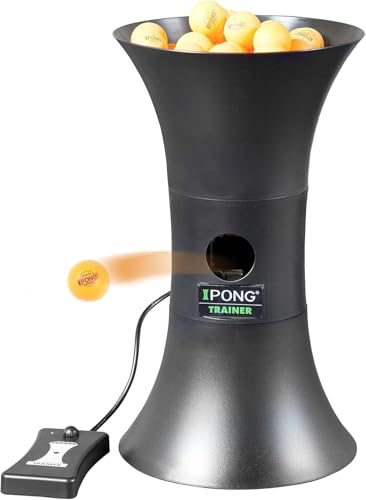
- Battery-powered and wireless
- Adjustable speed with wired remote
- Includes 80 ABS training balls
Best For: Beginners and portable solo practice
Best Programmable Pick

- 396 pre-saved ball trajectories
- App and E Pad remote control
- Programmable spin, speed, and placement
Best For: Structured and customizable solo training
Best Spin Variety

- Creates 36 spinning-ball variations
- Supports topspin, backspin, and sidespin
- Compact and easy to install
Best For: Spin-focused practice and portable use
Versatile Drill Builder
PONGBOT NOVA S Pro Table Tennis Robot

- 264 pre-saved drills
- Remote and smartphone app control
- Includes ball-recycling net
Best For: Players seeking varied, customizable solo practice
Smart Training Partner
PUSUN DORA Pro Table Tennis Robot

- Triple-motor serving system
- Real-time spin, speed, and landing adjustment
- Voice, app, and remote control
Best For: Players wanting precise, adjustable training sessions
Full-Court Practice
Dora Smart Pro Table Tennis Robot
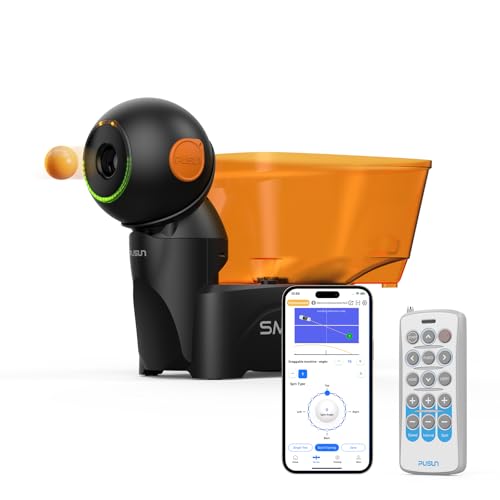
- Triple-motor launching system
- 200+ pre-saved drills
- Adjustable spin, speed, and landing points
Best For: Solo players focused on varied full-table practice
Best Smart-Controlled Pick – NOVA S Pro Table Tennis Robot
For players comparing table tennis robots, the NOVA S Pro stands out for its app-based customization and extensive drill library. It offers adjustable speed, frequency, spin, rotation intensity, and landing points, along with remote control for flexible solo practice.
Best For: Players and coaches who want highly customizable drills, app control, and advanced training options.
Pros:
- Includes 522 preset drills and supports custom drill programming.
- Offers 21 speed levels, 21 rotation levels, 11 frequency levels, and nine spin types.
- Supports app and remote control, including landing-point animation.
- Portable design with a near-net serve trajectory for short-range practice.
Cons:
- 40mm or larger balls and two AAA batteries are not included.
- The extensive controls may take time for beginners to learn.
The NOVA S Pro is a feature-rich option for structured, repeatable practice. Its one-year warranty and broad drill programming make it especially appealing to serious solo players, though simpler robots may be easier for basic training.
Best Recycling-Net Value – Suz S201 Table Tennis Robot
The Suz S201 is a practical choice among table tennis robots for players who want automatic ball recycling without repeatedly stopping to collect balls. It provides adjustable spin, speed, oscillation, and robot-head positioning, but it requires a compatible table and enough balls around the feeding tube.
Best For: Players seeking a recycling-net setup with adjustable serves and straightforward solo practice.
Pros:
- Includes a recycling net to return balls to the machine.
- Provides multiple options for spin, speed, and oscillation.
- Robot head can be adjusted for direct or indirect serves.
- Replacement parts are covered for normal wear and tear for one year.
Cons:
- Only fits table tennis tables less than 2.5 inches thick.
- Requires at least 20 balls around the feeding tube for proper serving.
- Setup and feeding adjustments may require careful attention to the manual.
The S201 focuses on convenience and repeatable practice rather than app-driven programming. Check your table thickness and plan to keep enough balls in the feeder area before choosing this model.
Best Lightweight Starter – JOOLA iPong V300 Robot
The JOOLA iPong V300 is one of the more approachable table tennis robots for beginners, families, and players who prefer simple controls over app-based programming. Its wireless remote adjusts frequency, speed, direction, and spin, while assembly only requires attaching the ball feeder.
Best For: Beginners, families, and players wanting a lightweight robot with quick setup.
Pros:
- Lightweight 3.1-pound design is easier to move and store.
- Wireless remote works from the opposite side of the table.
- Adjusts ball frequency from 30 to 70 balls per minute.
- Controls frequency, speed, direction, topspin, and backspin without an app.
Cons:
- The supplied notes do not indicate a recycling net or extensive preset drill library.
- Its feature set is more basic than app-controlled robots.
The iPong V300 is a sensible pick when ease of use and portability matter most. It offers enough adjustment for varied practice while avoiding the setup complexity associated with more advanced table tennis robots.
Best Programmable Drill Range – PONGBOT Table Tennis Robot
The PONGBOT is designed for players who want a broad selection of programmed table tennis robot drills. It combines remote and app control with 576 pre-saved trajectories, automatic oscillation, and adjustable frequency, ball speed, rotation, landing point, and height.
Best For: Players who prioritize a large drill library and programmable ball placement.
Pros:
- Includes 576 pre-saved trajectories for varied practice.
- Supports both remote and app control.
- Offers programmable frequency, speed, rotation, landing, and height.
- Automatic oscillation helps vary ball placement.
Cons:
- At 14 kg, it is substantially heavier than lightweight robot designs.
- The supplied notes do not specify warranty coverage or included components.
- Its tall dimensions may require more storage space.
With the largest stated trajectory library in this comparison, the PONGBOT is aimed at structured and varied training. Its heavier 14 kg build is worth considering if you expect to move or store the robot frequently.
Best Portable Pick – iPong Trainer Table Tennis Robot
The iPong Trainer is a straightforward option for shoppers comparing table tennis robots for solo practice. Its battery-powered design, wired speed control, quick setup, and compact size make it easy to use at home or take on the go.
Best For: Beginners, casual players, and anyone who wants a portable training robot with minimal setup.
Pros:
- Adjustable speed supports beginner practice and more challenging sessions.
- Battery-operated and wireless, so it can be placed conveniently on the table.
- Includes 80 round, durable 40mm ABS training balls.
- Compact 19-by-11-inch design and simple twist-on assembly.
Cons:
- The wired remote may be less convenient than app-based controls.
- The supplied notes do not mention programmable drills or trajectory presets.
Choose this iPong model if portability and ease of use matter more than advanced programming. It is a practical entry-level trainer from an established table tennis brand.
Best Programmable Pick – OMNI S Pro Table Tennis Robot
The OMNI S Pro is a feature-rich choice among table tennis robots, combining app and remote control with extensive drill customization. It offers 396 pre-saved trajectories plus settings for speed, spin, frequency, trajectory, and landing.
Best For: Players who want structured, customizable training and app-connected drill options.
Pros:
- Provides 396 pre-saved ball trajectories across 66 drills and multiple modes.
- Supports dual control through the E Pad S remote and Pongbot app.
- Allows programmable speed, spin, frequency, trajectory, and landing settings.
- Includes a ball recycling net for more convenient practice.
Cons:
- 40mm or 40mm+ balls are not included.
- At 19.8 pounds, it is substantially heavier than compact training robots.
- Its advanced controls may be more than casual beginners need.
For serious solo practice, the OMNI S Pro stands out for its drill library and customization. It is the strongest fit here for players who want repeatable, varied training sessions.
Best Spin Variety – HP-07 Ping Pong Robot Machine
The HP-07 is a compact option for shoppers seeking table tennis robots that emphasize spin practice. It can produce top spin, backspin, sidespin, and combinations of these, while its small footprint makes storage and transport easier.
Best For: Players focused on practicing varied spins with a compact automatic ball machine.
Pros:
- Offers 36 types of spinning balls, including topspin, backspin, and sidespin combinations.
- Supports double-end serving or optional single serving.
- Compact 12-by-10-by-11-inch design is convenient to carry.
- Simple installation requires no additional equipment.
Cons:
- Ping-pong balls are not included.
- Requires more than 15 standard 40mm balls to operate.
- The ball landing point is not fixed, according to the supplied notes.
The HP-07 is worth considering when spin variety is the priority. Remember to have enough international-standard 40mm balls available, since the machine needs a minimum quantity for dispensing.
Versatile Drill Builder – PONGBOT NOVA S Pro Table Tennis Robot
For players comparing table tennis robots, the PONGBOT NOVA S Pro stands out for its combination of guided practice and customization. It includes a ball-recycling net, remote control, smartphone app control, and 264 pre-saved drills.
Best For: Beginners through advanced players who want many ready-made drills plus the ability to create custom practice routines.
Pros:
- Includes a net to simplify setup and reduce ball collection.
- Offers both remote and smartphone app control.
- Provides 264 pre-saved drills and supports custom drills.
- Includes a one-year warranty.
Cons:
- The plastic construction may feel less substantial than a metal-framed machine.
- It is designed for one player at a time.
This is a practical choice if training variety matters most. Its extensive drill library and custom-drill capability make it adaptable, while the included net helps make solo sessions more convenient.
Smart Training Partner – PUSUN DORA Pro Table Tennis Robot
Among table tennis robots, the PUSUN DORA Pro is built for adjustable, low-interruption practice. Its triple-motor serving system, ball-recycling net, app and remote controls, and voice features support training sessions with real-time adjustments.
Best For: Players who want precise landing-point control, adjustable spin and speed, and extended practice without repeatedly collecting balls.
Pros:
- Three serving motors are designed for stable, precise landing points.
- Supports real-time speed, frequency, spin, and landing-point adjustments.
- Includes pre-saved drills and visually customizable full-court routines.
- Includes a ball-recycling net and dual app/remote control.
Cons:
- Only one control device can be connected at a time.
- Its listed dimensions are relatively long, so setup space should be checked.
The DORA Pro is a feature-rich option for players who want hands-on control during practice. Its recycling net and preset drills make it convenient, while the motor and adjustment features are suited to more structured training.
Full-Court Practice – Dora Smart Pro Table Tennis Robot
The Dora Smart Pro is a desktop option for players comparing table tennis robots with broad practice controls. It combines triple-motor launching, remote and app control, more than 200 pre-saved drills, and adjustable spin, speed, frequency, and landing points.
Best For: Solo players who want full-court coverage and the flexibility to build personal drills around different serve characteristics.
Pros:
- Triple motors are designed for more precise and stable launching.
- Offers more than 200 pre-saved drills with one-click startup.
- Supports random serves, variable speed and frequency, and adjustable spin.
- Allows personal drills and full-court landing-point coverage.
Cons:
- The supplied package information does not list a ball-recycling net.
- It is intended for one player at a time.
This model is a strong fit when coverage and serve variation are priorities. Its preset library simplifies startup, while the custom controls let players tailor sessions to receiving and placement practice.
How We Picked the Best Table Tennis Robots
We focused on the features that have the greatest effect on useful solo practice: ball delivery consistency, spin and speed adjustment, oscillation, drill programming, ball capacity, recycling design, and ease of control. We also considered whether each machine supports remote, app, or control-panel operation and whether its design suits casual home use or more structured training.
Because product specifications vary, check the current listing carefully for included balls, net dimensions, compatible ball sizes, power requirements, and app support before buying.
Quick Comparison
| Feature | Why It Matters | Best For |
|---|---|---|
| Ball capacity | Determines how often you need to reload during practice. | Long, uninterrupted sessions |
| Spin and speed controls | Help you practice serves, returns, blocks, and advanced strokes. | Players developing technique |
| Programmable drills | Creates repeatable routines and varied movement patterns. | Structured training |
| Recycling net | Collects and returns balls automatically. | Convenient home practice |
| App or remote control | Makes it easier to change settings while standing at the table. | Fast adjustments and custom sessions |
Key Buying Factors for Table Tennis Robots
Ball Delivery and Trajectory Control
Look for adjustable frequency, speed, placement, and oscillation. A machine with multiple pre-saved trajectories can provide more variety, while custom programming is valuable if you want to target specific footwork or stroke patterns.
Spin Range
Topspin, backspin, sidespin, and no-spin settings make practice more realistic. Beginners may prefer simple controls, while experienced players should prioritize independent spin and speed adjustment.
Capacity and Ball Recycling
A larger hopper reduces interruptions. A recycling net is especially useful in small home spaces because it gathers balls and can support continuous practice, but confirm that the net fits your table and room layout.
Controls, Setup, and Portability
Remote and app controls are convenient, but a straightforward onboard controller can be more dependable. Consider storage size, assembly, power access, and whether the machine can be moved easily after each session.
Ball Compatibility
Use the recommended 40 mm regulation balls and verify whether the machine is designed for ABS or another ball material. Consistent ball size and condition help prevent jams and maintain predictable shots.
Who Should Buy Which Table Tennis Robots?
Beginners: Choose a simple, stable model with basic speed, frequency, and placement controls. Ease of setup matters more than having hundreds of programmed drills.
Intermediate players: Prioritize adjustable spin, oscillation, a useful ball capacity, and programmable or pre-saved drills that can add movement and variation.
Advanced players and coaches: Look for independent control over spin, speed, placement, and frequency, along with extensive trajectory libraries or custom drill creation.
Small-space users: Favor compact desktop designs or machines with a recycling net that limits ball spread. Measure your table and clearance area before ordering.
Frequent solo trainers: Spend more on durable construction, dependable controls, higher capacity, and fast drill changes. The best choice is the model you can set up quickly and use consistently.