Tight calves can limit walking, running, squatting, and everyday mobility. The right calf stretcher can make regular stretching easier by providing a stable angle, controlled leverage, or adjustable support.
We compared 10 popular options, from compact foot rockers and straps to adjustable slant boards, to help you choose a calf stretcher for flexibility that fits your routine, comfort level, and available space.
Best 10 Calf Stretcher for Flexibility Picks for 2026
Best Overall
ProStretch Original Calf Stretcher

- Rocking design targets the lower leg
- Slip-resistant pads improve stability
- Includes QR stretching guide and 1-year warranty
Best For: Dedicated calf and foot stretching
Best Adjustable Option

- Five incline settings for progression
- Folds for home or gym transport
- Works with one or both feet
Best For: Adjustable lower-body stretching
Best Full-Body Stretching

- Works on calves, hips, hamstrings, and back
- Sturdy, lightweight steel-frame design
- Includes instructional card
Best For: Multi-area flexibility and recovery routines
Best for Foot Pain Support
PowerStep UltraFlexx Foot Rocker

- Stretches and strengthens the lower leg
- Non-skid base supports stable use
- Compact design targets foot-related stretching
Best For: Foot and calf flexibility support
Adjustable Training Pick

- Five adjustable angles from 23° to 45°
- Includes two latex-free resistance bands
- Portable 4.5-pound wooden design
Best For: Progressive stretching and resistance-band routines
Comfort-Focused Rocker

- Curved design supports a deeper foot stretch
- Nonslip surface helps with stability
- Fits shoe sizes up to US 12.5
Best For: Simple home foot, ankle, and calf stretching
Portable Rehab Choice

- Four incline positions from 30° to 45°
- Lightweight 5-pound wooden construction
- Useful for stretching, squats, and rehabilitation
Best For: Portable calf mobility and rehab routines
Best for Active Foot Control
Foot and Calf Fascia Stretcher

- Six adjustable loops for controlled stretching
- Targets calf, plantar fascia, thigh, and hip
- Wide foot strap with secure fasteners
Best For: Controlled daily stretching and mobility work
Best for Stable Standing Stretches

- Supports standing calf and ankle stretches
- Also works as a squat wedge and balance board
- Listed 1,000-pound maximum weight recommendation
Best For: Standing mobility work and fitness training
Best for Padded Rehabilitation
DMoose Foot and Calf Stretcher
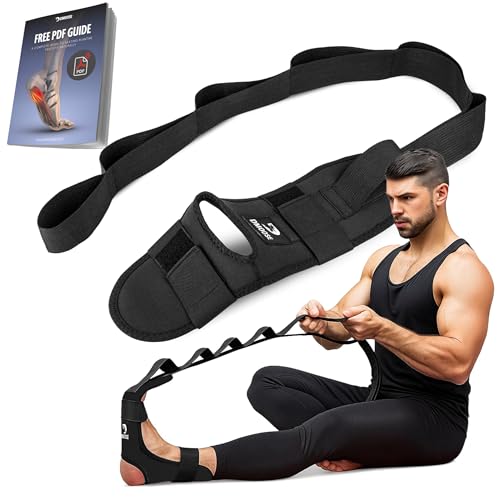
- 8 mm neoprene padding for cushioned support
- Seven loops provide flexible grip positions
- Includes an illustrated rehabilitation e-guide
Best For: Comfort-focused stretching and rehabilitation
Best Overall – ProStretch Original Calf Stretcher
If you want a focused calf stretcher for flexibility and lower-leg comfort, the ProStretch Original uses a rocker design to position the foot for a deeper, targeted stretch. Its slip-resistant rubber strips help keep it stable during use.
Best For: Users seeking a dedicated calf and foot rocker for tight calves, plantar fasciitis-related discomfort, or regular flexibility work.
Pros:
- Rocker design isolates the lower-leg muscles, tendons, and ligaments.
- Slip-resistant pads help reduce movement on different surfaces.
- Compact 14-ounce design, QR stretching guide, and one-year warranty.
- Made in the U.S.A. and accepted by the APMA, according to the supplied details.
Cons:
- Fits adult shoes up to size 12.
- Recommended weight limit is 250 pounds.
- Requires socks and rubber-soled athletic shoes.
The ProStretch is a practical choice when precise foot positioning matters more than adjustability. Follow the included guidance and use sturdy athletic footwear for a controlled stretch.
Best Adjustable Option – Portable 5-Angle Slant Board
This wooden slant board is a flexible choice for anyone comparing a calf stretcher for flexibility with adjustable resistance. Five incline settings let you progress from a gentler stretch to a more demanding position, while the foldable design supports home or gym use.
Best For: Beginners and experienced exercisers who want adjustable calf, ankle, heel, and leg stretching from one portable board.
Pros:
- Offers five angles: 23°, 30°, 35°, 40°, and 45°.
- Can be used with one or both feet and folds for transport.
- Supports stretching for calves, glutes, heels, ankles, and legs.
- Includes a workout poster and instructions.
Cons:
- At 4.6 pounds, it is heavier than a small foot rocker.
- The supplied details list no warranty.
- The board is relatively large at 15.7 by 11.69 inches.
Choose this model if adjustable intensity and broader lower-body use are priorities. Its wooden platform and multiple angles make it more versatile than a fixed-position stretcher, though less compact.
Best Full-Body Stretching – IdealStretch Leg Stretcher
The IdealStretch goes beyond a basic calf stretcher for flexibility by combining calf work with stretches for the hamstrings, hips, groin, back, knees, and glutes. Its manual steel-frame design is suited to users who want one tool for broader mobility training.
Best For: Athletes, seniors, yogis, dancers, and people working on multi-area flexibility or recovery routines.
Pros:
- Targets calves, hamstrings, hips, groin, knees, back, and glutes.
- Steel-frame construction provides a sturdy manual stretching platform.
- Lightweight at 2.3 pounds and includes an instructional card.
- Patented design supports flexibility training and hamstring recovery.
Cons:
- Its 220-pound maximum weight recommendation is lower than the slant board’s listed capacity.
- It is less specialized for foot positioning than a dedicated rocker.
- Requires manual positioning rather than adjustable angle settings.
This is the better fit when calf flexibility is only one part of your routine. For a simple, foot-focused stretch, a rocker may be more direct; for broader mobility work, the IdealStretch offers greater range.
Best for Foot Pain Support – PowerStep UltraFlexx Foot Rocker
The PowerStep UltraFlexx is a compact foot rocker for shoppers seeking a calf stretcher for flexibility that also addresses common foot and lower-leg concerns. It holds the foot in position for stretching and strengthening, with a non-skid base for added stability.
Best For: Adults focusing on foot and calf stretching associated with plantar fasciitis, Achilles tendonitis, tight calves, ball-of-foot pain, or shin splints.
Pros:
- Designed to stretch and strengthen foot and lower-leg muscles, ligaments, and tendons.
- Non-skid rocker bottom helps hold the foot stable.
- Lightweight 0.4-kilogram plastic construction is easy to store.
- Provides a deep stretch while supporting flexibility work.
Cons:
- The supplied details do not provide a specific weight limit.
- It is intended for use with sturdy athletic shoes.
- Its fixed rocker format offers less angle adjustment than a slant board.
For a small, straightforward rocker aimed at foot and lower-leg stretching, the UltraFlexx is a practical option. Its main advantage is focused use, while users wanting progressive angles or full-body stretching should consider another format.
Adjustable Training Pick – Calf Stretch Slant Board
If you want a versatile calf stretcher for flexibility, this adjustable wooden slant board offers five incline settings for gradually increasing the challenge. Its portable design and included resistance bands make it useful for stretching, strengthening, and rehabilitation routines.
Best For: Users who want adjustable calf stretching plus resistance-band exercises at home, the gym, or a therapy setting.
Pros:
- Five angles from 23° to 45° support progressive stretching.
- Non-slip EVA base and PVC sandpaper surface help provide stability.
- Includes two latex-free TPE resistance bands, a guide poster, and an instruction manual.
- Lightweight 4.5-pound wooden construction is easy to transport.
Cons:
- Its compact platform may feel limited for users seeking a larger standing surface.
- The resistance bands add versatility but may require separate storage.
With multiple incline levels and extra training accessories, this is a strong choice for buyers who want more than a basic calf board. The adjustable setup also makes it easier to begin gently and progress over time.
Comfort-Focused Rocker – Curved Foot Calf Stretcher
This foot rocker is a straightforward option for anyone seeking a calf stretcher for flexibility without adjusting an incline board. Its curved, angled shape positions the foot for a deeper stretch while the nonslip surface helps maintain a steady stance.
Best For: Beginners, seniors, and home users looking for a compact foot-and-calf stretching tool with a comfort-oriented rocker shape.
Pros:
- Curved surface contours to the foot and is designed to reduce joint strain.
- Angled construction promotes consistent foot positioning during stretches.
- Supports up to 300 pounds and accommodates shoe sizes up to US 12.5.
- Nonslip surface helps provide stability during use.
Cons:
- It offers one fixed stretching design rather than adjustable angle settings.
- Plastic construction may be less substantial than a wooden slant board.
- The included components list contains only the foot rocker.
Choose this model if simplicity and foot comfort matter more than exercise versatility. It is designed primarily for targeted foot, ankle, and calf stretching rather than multi-position training.
Portable Rehab Choice – Adjustable Wooden Slant Board
This wooden slant board is a practical calf stretcher for flexibility when you want an adjustable platform for stretching, squats, and weight-bearing exercises. Four incline positions let beginners start at a manageable angle and progress toward a more demanding stretch.
Best For: Home, office, gym, and physiotherapy users who want a lightweight board for calf mobility, stretching, and rehabilitation exercises.
Pros:
- Four adjustable positions range from 30° to 45°.
- Lightweight 5-pound wooden construction is portable.
- Suitable for beginners, experienced athletes, and various fitness levels.
- Can support stretching, squats, posture work, and rehabilitation training.
Cons:
- It has fewer angle settings than some adjustable slant boards.
- No resistance bands or other accessories are included.
- The supplied notes do not specify a maximum supported weight.
This board suits buyers who want a simple, portable platform with enough angle range for everyday stretching and rehabilitation. Its accessory-free design keeps the focus on controlled lower-leg and foot exercises.
Best for Active Foot Control – Foot and Calf Fascia Stretcher
If you want a calf stretcher for flexibility that lets you control the intensity yourself, this adjustable fascia stretcher is a practical option. Its cradle design, six loops, and wide foot strap support targeted stretching for the calf, plantar fascia, thigh, and hip.
Best For: Users seeking controlled stretching for morning heel discomfort, calf tightness, plantar fasciitis, or general mobility work.
Pros:
- Six adjustable loops allow precise control over stretch intensity and duration.
- Designed to support calf, plantar fascia, thigh, and hip stretching.
- Wide foot strap and secure fasteners help maintain a stable fit.
- Lightweight nylon construction measures 60 inches long and fits most adult shoe sizes.
Cons:
- Requires active use rather than providing a hands-free or overnight stretch.
- One-size design may not offer a fully customized fit for every user.
This is a versatile strap for people who prefer to adjust their own stretch and use it for short daily sessions, including before taking the first steps in the morning.
Best for Stable Standing Stretches – Slant Board Calf Stretcher
This slant board is a solid choice if you prefer a standing calf stretcher for flexibility and ankle-mobility training. The angled EVA platform can also function as a squat wedge and balance board, making it suitable for stretching and fitness drills.
Best For: Adults who want a stable platform for calf stretching, ankle mobility, balance practice, and exercise support.
Pros:
- Supports calf stretching, flexibility, balance, and ankle mobility work.
- Can be used as a squat wedge and balance board.
- EVA construction has a listed maximum weight recommendation of 1,000 pounds.
- Compact 16-by-6.5-by-3.25-inch design is easy to position for home workouts.
Cons:
- Provides a fixed angle rather than strap-based adjustment.
- Its standing format may be less suitable for users who need seated or passive stretching.
Choose this board when you want a straightforward, weight-bearing tool that combines calf stretching with balance and lower-body exercise applications.
Best for Padded Rehabilitation – DMoose Foot and Calf Stretcher
For users prioritizing comfort, this padded calf stretcher for flexibility combines an adjustable foot strap with multiple hand loops. The 8 mm neoprene padding is designed to reduce strain during stretching, while the included e-guide offers step-by-step exercise guidance.
Best For: Beginners, rehabilitation users, and athletes who want cushioned support for calf, hamstring, foot, and lower-leg stretching.
Pros:
- 8 mm neoprene padding helps provide cushioned support during rehabilitation.
- Seven hand loops offer multiple grip positions and tension options.
- Dual hook-and-loop straps provide an adjustable fit for different foot sizes.
- Includes an e-guide with illustrated rehabilitation exercises.
Cons:
- The strap-based design requires active hand control during use.
- At 52 inches long, it offers less length than some larger stretching straps.
This model stands out for its padding and guided approach, making it a useful pick for consistent stretching sessions where comfort and technique support matter.
How We Picked the Best Calf Stretcher for Flexibility
We evaluated each option for adjustability, stability, portability, comfort, and ease of use. We also considered how well each design supports gradual stretching of the calves, feet, ankles, and related muscle groups. Products with adjustable angles or straps can accommodate different flexibility levels, while rigid boards and rockers may provide a more consistent setup.
Because needs vary, this list includes several formats rather than ranking every product by a single feature. A compact rocker may suit quick sessions, while a slant board can be more useful for standing stretches, squats, and physical-therapy-style exercises.
Quick Comparison
| Design | Best For | Main Advantage |
|---|---|---|
| Foot rocker | Targeted standing stretches | Simple leverage and compact storage |
| Slant board | Calf stretching and lower-body exercises | Stable platform with adjustable incline options |
| Stretching strap | Seated or lying-down routines | Controlled range of motion and portability |
| Combined board and band | More varied home workouts | Stretching plus resistance-training versatility |
Key Buying Factors for a Calf Stretcher for Flexibility
Angle and Adjustability
A fixed rocker or incline can be convenient, but adjustable models let you begin gently and increase the stretch over time. Multiple angle settings are especially useful when more than one person will use the device.
Stability and Weight Capacity
Look for a broad, non-slip base and a construction suited to your body weight and intended exercises. A stable board is important for standing stretches, balance work, and loaded movements such as squats.
Comfort and Control
Padding, textured foot surfaces, and adjustable straps can make longer sessions more comfortable. Straps are useful when you want to control the stretch without placing all your weight on the feet or ankles.
Portability and Storage
If you travel or have limited space, prioritize lightweight rockers and straps. Wooden or larger slant boards may provide greater stability but typically need more storage room.
Intended Use
Decide whether you want basic flexibility work, support for a home exercise routine, or a tool for following professional rehabilitation instructions. A calf stretcher should complement—not replace—guidance from a qualified clinician when pain or injury is involved.
Who Should Buy Which Calf Stretcher for Flexibility?
Choose a foot rocker if you want a quick, focused stretch while standing. Select an adjustable slant board if you want multiple incline levels, greater stability, or a platform that can support broader lower-body exercises. A stretching strap is the best fit for seated routines, travel, and users who prefer gradual manual control.
For a more versatile home setup, consider a board that includes a resistance band. If portability is your priority, choose a compact rocker or strap. Whichever style you select, start with a comfortable range, move slowly, and stop if you experience sharp pain, numbness, or worsening symptoms.