Choosing the right Pilates chair for a studio requires more than comparing prices. Resistance control, frame stability, pedal design, adjustability, and member comfort all affect how useful the equipment will be in regular classes.
We compared 10 Pilates chairs across these practical criteria to help studio owners, instructors, and dedicated home users find equipment that fits their space, programming, and budget.
Best 10 Pilates Chairs for Studio Use Picks for 2026
Solid-Oak Studio Workhorse

- Solid oak frame supports up to 351 pounds
- Four spring positions and two resistance levels
- Includes handles, split pedals, bands, and wheels
Best For: Studios needing a stable, versatile chair for varied routines
Balanced Body Compact Pick

- Eight adjustable resistance levels
- Lightweight 55-pound design
- Compact and stackable for easier storage
Best For: Space-conscious studios and portable Pilates setups
Full-Feature Oak Trainer
Professional Split-Pedal Chair

- Solid oak frame supports up to 380 pounds
- Four spring positions with 30- and 60-pound resistance
- Includes split pedals, bands, adjustable handles, and wheels
Best For: Professional studios needing broad exercise versatility
Metal-Frame Value Option
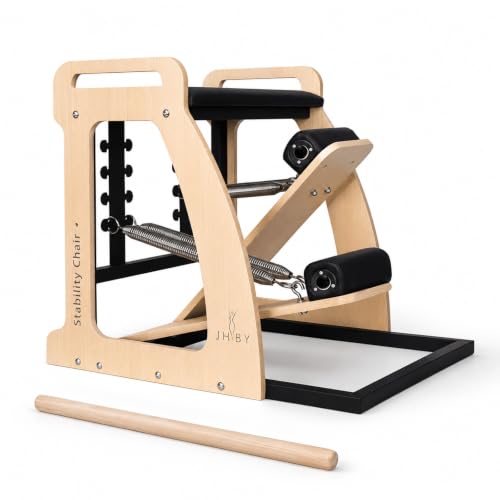
- Wood and stainless-steel frame
- Four spring positions for resistance changes
- Detachable design with padded surfaces
Best For: Straightforward Pilates training in space-conscious setups
Rehab-Ready Choice
LeisureKing Pilates Combo Chair
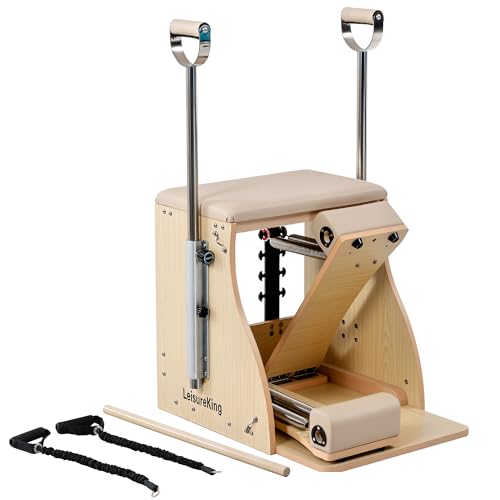
- Split pedals support targeted balance work
- Five handle heights and four spring positions
- Casters and compact footprint aid studio storage
Best For: Mixed-experience, senior, and rehabilitation-focused studios
Classic Studio Build
Split-Pedal Stability Combo Chair

- Three-height removable padded handles
- Quick spring changes with incremental resistance
- Maple-faced laminate and upholstered seat
Best For: Studios seeking a polished, traditional chair setup
High-Capacity Pick

- 330-pound stated maximum weight recommendation
- Four resistance levels with durable springs
- Compact design supports upright storage
Best For: Studios prioritizing capacity, stability, and space efficiency
Best Value Stability Chair
Plates Combo Chair with Handles

- Four spring positions for adjustable resistance
- 300-pound capacity with lightweight 40-pound design
- Two-year manufacturer quality guarantee
Best For: Compact studios and home gyms prioritizing portability
Best for Adjustable Fit
LeisureKing Pilates Combo Chair

- Five adjustable handle heights
- Compact 5-square-foot footprint with casters
- Includes resistance bands and split pedals
Best For: Small studios and rehabilitation-focused training areas
Best Simple Pick

- Supports up to 400 pounds
- Four springs and four handle heights
- Includes straps and non-slip Pilates socks
Best For: Studios needing capacity and rehabilitation flexibility
Solid-Oak Studio Workhorse – Adjustable Combo Wunda Chair
For shoppers comparing pilates chairs for studio use, the PAETA Combo Chair stands out with a solid-oak frame, support handles, split pedals, and included resistance bands. Its adjustable springs and mobility wheels make it suitable for varied sessions and studio repositioning.
Best For: Studios and serious home users wanting a durable, highly adjustable Pilates chair with expanded exercise options.
Pros:
- Solid oak frame supports up to 351 pounds.
- Two color-coded resistance levels and four spring positions allow customization.
- Includes adjustable handles, split pedals, resistance bands, and mobility wheels.
- High-density foam padding and a two-year frame warranty add comfort and reassurance.
Cons:
- At 84 pounds, it is heavier than more portable chair options.
- Assembly is required, although an installation video is included.
Its combination of stability, accessories, and resistance adjustability makes this a strong choice when a studio needs one chair to support multiple exercise formats.
Balanced Body Compact Pick – EXO Single-Pedal Chair
The Balanced Body EXO is a compact option among pilates chairs for studio use, especially where storage and portability matter. Its two springs provide eight resistance levels, while the single-pedal design keeps the setup straightforward for home or studio workouts.
Best For: Smaller studios, instructors, and home users seeking a lightweight chair from an established Pilates equipment brand.
Pros:
- Eight resistance levels support progressive workout customization.
- At 55 pounds, it is relatively lightweight and portable.
- Compact, stackable design helps with storage.
- Includes a streaming workout video for guidance.
Cons:
- This version uses a single pedal rather than a split-pedal configuration.
- The supplied notes do not mention included resistance bands or a frame warranty.
The EXO prioritizes portability and resistance range over extra accessories, making it a practical fit for studios that frequently rearrange equipment or have limited space.
Full-Feature Oak Trainer – Professional Split-Pedal Chair
The Holymuss chair is designed for buyers seeking feature-rich pilates chairs for studio use. Its solid-oak construction, adjustable support handles, detachable pedals, resistance bands, and built-in wheels support a broad range of seated, standing, and lying exercises.
Best For: Professional studios and multipurpose training spaces that want a sturdy chair with Reformer-inspired accessories.
Pros:
- Solid oak construction supports up to 380 pounds.
- Color-coded 30- and 60-pound springs offer four adjustment positions.
- Split pedals, dual-position resistance bands, and three-height handles expand exercise variety.
- Includes wheels, a two-year frame warranty, replacement parts, and 24/7 support.
Cons:
- The 84-pound weight may make frequent lifting inconvenient.
- Setup is required, despite the included installation guidance.
This chair offers one of the broadest feature sets in the group, with the durability and adjustability suited to varied users and repeated studio sessions.
Metal-Frame Value Option – Stability Pilates Chair
For buyers looking for straightforward pilates chairs for studio use, this black stability chair combines a wood-and-metal frame with padded contact points and four spring positions. Its detachable design is useful when equipment must be assembled, disassembled, or stored between sessions.
Best For: Budget-conscious buyers who want a basic resistance-based Pilates station for a dedicated workout area.
Pros:
- Wood and stainless-steel construction provides a sturdy training base.
- Four spring positions allow resistance adjustment.
- Non-slip handle grips and padded surfaces support comfort and control.
- Detachable components can help with home setup and storage.
Cons:
- The supplied notes do not specify a weight capacity.
- Only the Pilates chair is listed as an included component; bands are not mentioned.
- Assembly is required before use.
This is a relatively simple choice for studios or home spaces that need core chair functionality without the larger accessory package found on the oak combo models.
Rehab-Ready Choice – LeisureKing Pilates Combo Chair
For studios seeking versatile pilates chairs for studio use, the LeisureKing Combo Chair combines split-pedal training, adjustable handles, resistance bands, and seated rehabilitation support. Its compact footprint and casters also make repositioning practical.
Best For: Studios serving mixed-experience clients, seniors, or rehabilitation users.
Pros:
- Split pedals support balance assessment and isolated-side training.
- Five handle heights and four spring positions accommodate different users.
- Wood frame, anti-slip cushioning, and a stated 220-pound capacity provide supportive positioning.
- Quiet casters and a roughly six-square-foot footprint simplify studio layout changes.
Cons:
- Its stated weight capacity is lower than some competing options.
- Although partly assembled, the remaining setup is estimated at 30 minutes.
The LeisureKing stands out when a studio prioritizes accessibility and rehabilitation-friendly adjustments. Its combination of mobility and split-pedal functionality makes it a flexible option for varied programming.
Classic Studio Build – Split-Pedal Stability Combo Chair
This split-pedal chair is a straightforward contender among pilates chairs for studio use, pairing adjustable handles with quick spring changes and a polished maple-faced hardwood laminate finish. It is designed to add compact, targeted strength and stretching work to a home or studio setup.
Best For: Studios wanting a traditional-looking chair with broad incremental resistance options.
Pros:
- Removable, padded handles adjust quickly to three heights.
- Cactus Springtree System and easy-grip tabs simplify spring changes.
- Two pedals with two springs each offer heavy- and light-resistance choices.
- Maple-faced hardwood laminate and an upholstered seat provide a polished appearance.
Cons:
- The supplied notes do not specify a maximum user weight.
- Only three handle heights are listed, fewer than some adjustable alternatives.
This model is best suited to studios that value a clean, furniture-like presentation and efficient resistance adjustments. Confirm capacity and dimensions before outfitting a larger facility.
High-Capacity Pick – AddWin Wunda Chair
The AddWin Wunda Chair offers a sturdy, compact option for pilates chairs for studio use, with split pedals, adjustable support bars, four resistance levels, and a stated 330-pound capacity. Its reinforced structure and easy-clean upholstery are practical for frequent training.
Best For: Studios needing a higher-capacity chair with adjustable resistance and space-conscious storage.
Pros:
- Four resistance levels use two red 60-pound and two green 30-pound springs.
- Reinforced triangle construction, non-slip handles, and a solid wood frame support stability.
- Supports up to 330 pounds, according to the supplied specifications.
- Compact dimensions and upright storage design help conserve space.
Cons:
- At about 67 pounds, it may require more effort to move than lighter equipment.
- The listed dimensions make it taller and larger than some compact chair designs.
With its higher stated capacity, durable spring testing, and water-resistant PU leather surface, the AddWin is a strong practical choice for busy studio environments. Its footprint should still be measured against the planned layout.
Best Value Stability Chair – Plates Combo Chair with Handles
For shoppers comparing pilates chairs for studio use, this maple stability chair offers a compact, manually operated setup with handles, split-pedal training, and four spring positions. Its wood-and-metal frame supports users up to 300 pounds and is designed for strength, balance, flexibility, and controlled movement.
Best For: Studios and home gyms seeking a lightweight, stackable chair with adjustable resistance and broad age-range usability.
Pros:
- Four spring positions allow resistance adjustments for different training needs.
- Supports up to 300 pounds while weighing 40 pounds for easier handling.
- Handles, split-pedal functionality, and full-body exercise options expand training variety.
- Includes a two-year manufacturer quality guarantee.
Cons:
- The supplied dimensions are listed as 10 x 10 x 10 inches, so verify the actual footprint before outfitting a studio.
- Assembly is required.
Choose this model when portability, straightforward resistance adjustment, and warranty coverage matter more than a larger commercial-style footprint.
Best for Adjustable Fit – LeisureKing Pilates Combo Chair
This black LeisureKing chair is a practical option among pilates chairs for studio use, combining split pedals, five handle heights, four spring positions, and resistance-band attachment points. Its 5-square-foot footprint and quiet-rolling casters make it convenient for studios that frequently reposition equipment.
Best For: Small studios, rehabilitation spaces, and users who need multiple handle-height and resistance-band adjustments.
Pros:
- Five handle heights accommodate different body types and experience levels.
- Split pedals support unilateral balance and targeted training.
- Quiet-rolling casters simplify relocation, while the compact footprint saves space.
- Includes resistance bands and arrives 60% assembled.
Cons:
- The stated weight capacity is 220 pounds, lower than the other listed chairs.
- Warranty coverage is limited to one year for parts.
- Final assembly is still required, with about 30 minutes specified.
This is a strong fit when adjustability and mobility are central requirements, but studios serving heavier users should compare the 220-pound limit carefully.
Best Simple Pick – Studio-Grade Wunda Chair
For studios needing a higher stated load rating, this wood Pilates combo chair supports up to 400 pounds and combines split pedals, adjustable handles, four resistance springs, and elastic straps. Its 30 x 24 x 44-inch footprint is compact compared with a reformer, while the spring options are designed for both progressive training and gentler rehabilitation work.
Best For: Studios and home gyms that prioritize high weight capacity, adjustable resistance, and rehabilitation-oriented exercise options.
Pros:
- High-grade wood panels and reinforced joints are rated to support up to 400 pounds.
- Four spring resistance levels include extra-short springs for gentler training.
- Four adjustable handle heights and split pedals support alignment and unilateral movements.
- Includes elastic resistance straps and non-slip Pilates socks.
Cons:
- The listed warranty is only three months.
- Its 30 x 24 x 44-inch dimensions require more floor and vertical clearance than a very compact chair.
- Assembly is required, with an instruction manual and installation video supplied.
This chair stands out for capacity and configurability, making it a compelling option for varied users, though the short warranty deserves careful consideration for studio purchasing.
How We Picked the Best Pilates Chairs for Studio Use
We focused on features that matter during repeated instruction and daily workouts: frame construction, pedal configuration, resistance options, handle adjustability, user support, and overall versatility. Chairs with split pedals and adjustable handles can support a broader range of exercises, while resistance bands or springs may provide additional programming options.
Because product listings can vary by seller, verify dimensions, maximum user weight, included accessories, warranty coverage, and assembly requirements before ordering. A chair that suits occasional home workouts may not be durable or adjustable enough for a busy studio.
Quick Comparison
- Best for adjustability: Look for multi-position handles, adjustable resistance, and split pedals.
- Best for compact studios: Choose a stable chair with a relatively small footprint and easy storage options.
- Best for varied classes: Combo chairs with handles, resistance bands, and independent pedals offer more exercise possibilities.
- Best for instructors: Prioritize predictable resistance changes, secure hardware, and comfortable access around the chair.
Key Buying Factors for Pilates Chairs for Studio Use
Stability and Construction
A studio chair should remain planted during standing, seated, and unilateral movements. Inspect the base, frame materials, pedal hinges, and non-slip feet. A heavier, rigid frame generally feels more secure, although it may be harder to move.
Resistance and Pedal Design
Split pedals allow independent leg movement and can expand exercise selection. Check whether resistance is provided by springs, bands, or both, and whether settings can be changed quickly between users. Consistent resistance is especially important for teaching progression safely.
Adjustability and User Fit
Adjustable handles help accommodate different heights and exercise positions. Consider seat dimensions, pedal reach, handle padding, and the range of adjustment. If multiple clients will use the chair, flexibility is usually more valuable than a fixed configuration.
Space, Setup, and Maintenance
Measure the chair and leave enough clearance for the instructor and client to move safely. Confirm whether assembly is required and whether replacement bands, springs, or hardware are available. Smooth hinges, secure fasteners, and wipe-clean upholstery can reduce maintenance demands.
Who Should Buy Which Pilates Chairs for Studio Use?
Small studios and multipurpose rooms should favor compact, versatile combo chairs with adjustable handles and split pedals. High-use professional studios should prioritize the strongest frame, stable base, dependable resistance hardware, and warranty support over the lowest price.
Independent instructors may prefer a portable model with useful accessories and straightforward setup. Home users can often choose a simpler Pilates chair if they need occasional workouts, but should still verify stability, dimensions, and resistance suitability. For any of these buyers, the best Pilates Chairs for Studio Use are the ones that match the expected workload while allowing safe, repeatable adjustments for different users.