Incline sprint workouts can build power, conditioning, and running strength without requiring a hill outside. The best home treadmills combine meaningful incline adjustment with enough speed, belt space, stability, and cushioning for hard intervals.
This roundup compares 10 options across compact folding models, higher-capacity treadmills, and machines with steeper grades. Use the guide below to match your training style, available space, and budget to the right treadmill.
Best 10 Incline Treadmills for Sprint Training Picks for 2026
Best Overall Value
THERUN 16% Incline Folding Treadmill

- Up to 15% automatic incline
- 10 MPH maximum speed
- Folding, Bluetooth-connected design
Best For: Home incline intervals and everyday running
Best for Guided Workouts

- iFIT guided and adaptive workouts
- 0–10% incline range
- 55-inch cushioned running deck
Best For: Trainer-led home cardio and interval sessions
Best for High-Incline Intervals

- 0–20% incline range
- 12 MPH maximum speed
- 400-pound capacity with 5.0 HP motor
Best For: Steep hill sprints and heavy-duty home training
Best Compact NordicTrack

- Foldable space-saving frame
- 0–10% incline and 10 MPH speed
- 20-inch-wide cushioned deck
Best For: Small-space runners using moderate incline intervals
Best Compact Hill-Sprint Treadmill

- Hill Sprints mode with three manual incline levels
- Wide cushioned belt for stable home workouts
- Folds compactly and supports up to 300 pounds
Best For: Space-conscious users training with incline intervals and hill sprints
Best High-Incline Budget Pick

- Steep 16% manual incline for hill conditioning
- 3.0 HP brushless motor with low-noise operation
- 400-pound capacity and compact folding design
Best For: Apartment users prioritizing steep incline work over maximum sprint speed
Best App-Connected Incline Treadmill

- 15-level auto incline for structured intervals
- App connectivity with preset and coach-led workouts
- Cushioned 17.3-inch belt and 320-pound capacity
Best For: Users seeking guided, automated incline workouts at home
Best Compact Manual-Incline Pick
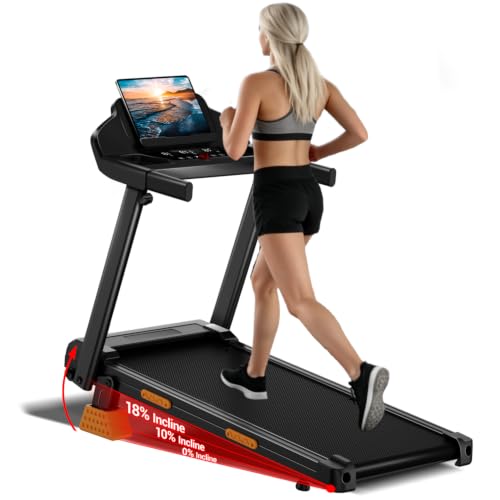
- 0%, 8%, and 18% manual incline settings
- 400-pound capacity with shock-absorbing belt
- Folds compactly and weighs about 40 pounds
Best For: Compact hill walking, jogging, and controlled intervals
Best Smart Sprint-Training Option

- 15 automatic incline levels with sprint-climbing mode
- 10 MPH top speed and wide 19-inch belt
- App coaching, Bluetooth, and hydraulic folding
Best For: Automated hill intervals and connected home training
Best Steep-Incline Capacity Pick

- 20-level automatic incline reaches 20%
- 400-pound capacity with quiet brushless motor
- Folds nearly flat to 6.5 inches
Best For: Steep incline HIIT, power walking, and moderate running
Best Overall Value – THERUN 16% Incline Folding Treadmill
For shoppers comparing incline treadmills for sprint training, the THERUN offers a practical mix of incline adjustment, a wide belt, and a folding frame. Its 10 MPH top speed and up-to-15% listed incline suit short uphill intervals, steady runs, and walking workouts.
Best For: Home users who want a compact, app-connected treadmill for incline intervals and everyday running.
Pros:
- Automatic incline adjustment with quick-access controls.
- 17-inch-wide, five-layer belt provides traction and additional running space.
- Bluetooth app support tracks speed, incline, distance, calories, and heart rate.
- Folding design arrives mostly assembled and includes transport wheels.
Cons:
- Its 10 MPH maximum speed may limit all-out sprint work.
- The listed deck length is 47.2 inches, which may feel short for longer strides.
- Warranty coverage is listed as one year.
The THERUN is a sensible value pick for runners prioritizing incline work, storage convenience, and basic workout tracking over top-end sprint speed.
Best for Guided Workouts – NordicTrack T Series T5
The NordicTrack T5 is a guided-training option among incline treadmills for sprint training. Its 10 MPH speed ceiling and 0–10% incline range support beginner-to-intermediate intervals, while iFIT can automatically adjust the treadmill during compatible workouts.
Best For: Runners who prefer trainer-led sessions, adaptive workouts, and connected fitness features.
Pros:
- iFIT offers guided workouts with automatic speed and incline changes, membership required.
- KeyFlex cushioning is designed to reduce impact during running.
- Bluetooth connectivity supports compatible heart-rate and fitness-app features.
- 55-inch deck and 18-inch width provide useful running space.
Cons:
- The 10% incline is less aggressive than several competing models.
- Top speed is limited to 10 MPH for sprint training.
- Many smart features require an iFIT Train Membership.
The T5 makes the most sense when structured coaching and adaptive workouts matter more than maximum incline or high-speed sprint capability.
Best for High-Incline Intervals – 20% Incline Folding Treadmill
With a 12 MPH top speed and 0–20% incline range, this model is the strongest match here for incline treadmills for sprint training. Its heavy-duty frame, 400-pound capacity, and cushioned belt are aimed at demanding home workouts that include hill sprints and repeated intervals.
Best For: Users who want steep hill training, higher speed, and a heavy-duty home treadmill.
Pros:
- 20% incline range supports steep hill climbs and incline sprints.
- 12 MPH maximum speed provides more room for faster intervals.
- 5.0 HP brushless motor and 400-pound capacity emphasize heavy-duty use.
- Seven-layer belt with air cushions is designed for impact absorption.
Cons:
- The 18-by-50-inch belt is narrower and shorter than some full-size running decks.
- Its extensive preset-program feature set may be more than casual users need.
- Smartphone app features depend on Bluetooth connectivity.
This is the most performance-oriented choice in the group, particularly for runners who will regularly use steep inclines and speeds above 10 MPH.
Best Compact NordicTrack – NordicTrack T Series T6.5S
The NordicTrack T6.5S combines a 10 MPH maximum speed with 0–10% incline adjustment in a folding design. For shoppers seeking incline treadmills for sprint training, it fits controlled intervals and endurance work, though its speed and incline range are better suited to moderate sessions than advanced hill sprints.
Best For: Small-space users who want a foldable treadmill with cushioning and optional iFIT coaching.
Pros:
- Folding frame is designed for compact storage.
- 55-inch by 20-inch deck offers generous width for home running.
- KeyFlex cushioning supports smoother, lower-impact strides.
- iFIT can automatically adjust speed and incline during compatible workouts.
Cons:
- 10 MPH top speed limits maximal sprint work.
- Its 10% incline is modest for dedicated hill training.
- iFIT coaching and connected features require a membership.
The T6.5S is a practical compact pick for runners who value storage and guided training, but serious sprinters may prefer a faster treadmill with a steeper incline.
Best Compact Hill-Sprint Treadmill – MERACH MR-T12
For shoppers comparing incline treadmills for sprint training, the MERACH MR-T12 stands out for its dedicated hill-sprint mode, manual incline adjustment, and compact folding design. Its 0.5–7.5 MPH speed range supports walking, jogging, and controlled sprint intervals, while the wide belt and cushioning help provide a more stable workout surface.
Best For: Home users who want hill-sprint and incline workouts in a space-conscious treadmill.
Pros:
- Three incline levels and dedicated Hill Sprints, Power Hiking, and Steady-State Climb modes
- Wide 16.5-by-42.5-inch belt with a seven-layer design and 12 shock absorbers
- 300-pound capacity, foldable frame, and hydraulic folding system
- MERACH app support, LCD workout tracking, and heart-rate monitoring
Cons:
- Manual incline requires changing the setting rather than adjusting it during a workout
- Maximum speed is 7.5 MPH, which may limit all-out sprint training
- One-year warranty is shorter than some competitors’ coverage
This is a practical choice for incline intervals and hill-focused conditioning rather than maximum-speed sprint work. Its belt width, cushioning, and folding mechanism make it especially appealing for home gyms with limited space.
Best High-Incline Budget Pick – CURSOR FITNESS SF20
The CURSOR FITNESS SF20 is a compact option for incline treadmills for sprint training when steep hill work matters more than top-end speed. Its 0–16% manual incline provides a challenging grade, while the 0.6–7.2 MPH range is suited to incline walking, jogging, and shorter controlled intervals.
Best For: Apartment users seeking a high-incline treadmill for hill conditioning and general home workouts.
Pros:
- 16% manual incline offers a steep setting for hill-focused training
- 3.0 HP brushless motor with a stated speed range up to 7.2 MPH
- 400-pound maximum weight recommendation
- Foldable, 90% pre-assembled design with transport-friendly storage dimensions
Cons:
- Manual incline changes are less convenient during interval sessions
- 15-by-37.5-inch belt is narrower and shorter than the other listed options
- Top speed may not satisfy advanced runners seeking full-speed sprints
The SF20’s main advantage is its 16% incline, making it a strong fit for steep uphill intervals and calorie-focused conditioning. The relatively compact running surface and moderate speed ceiling make it better suited to controlled training than long-stride sprinting.
Best App-Connected Incline Treadmill – MERACH T12
For runners who want incline treadmills for sprint training with more automated workout variety, the MERACH T12 combines 15 incline levels, a 0.5–7.5 MPH speed range, and 12 preset programs. Its auto-incline capability and app connectivity make it useful for structured incline intervals, while the wide belt and shock-absorbing deck support everyday home training.
Best For: Users who want app-guided incline workouts, preset programs, and automatic grade changes.
Pros:
- 15 incline levels from 0% to 15% with auto-incline functionality
- 12 preset programs plus MERACH app features, scenic routes, and coach-led classes
- 3.0 HP motor with a stated operating noise level below 42 dB
- 43.3-by-17.3-inch belt, cushioning components, and 320-pound capacity
Cons:
- 7.5 MPH maximum speed may be limiting for advanced sprint athletes
- Folded dimensions still require more storage space than an ultra-compact walking pad
- App-based features may be unnecessary for users who prefer simple manual workouts
The T12 is the most feature-oriented choice of the three, particularly for runners who value automatic incline transitions and guided training content. It works well for incline intervals and conditioning, though serious sprinters may want a machine with a higher maximum speed.
Best Compact Manual-Incline Pick – LONTEK 18% Incline Treadmill
For shoppers comparing incline treadmills for sprint training, the LONTEK SF20 offers a steep 18% manual incline and speeds up to 7.5 MPH in a lightweight, foldable design. It is better suited to walking, jogging, hill work, and steady intervals than all-out sprinting.
Best For: Apartment users and beginners who want steep incline training, compact storage, and a high stated weight capacity.
Pros:
- Manual incline settings of 0%, 8%, and 18% increase hill-work intensity.
- Supports up to 400 pounds and uses a seven-layer belt with four shock absorbers.
- Lightweight folding design stores under beds, sofas, or in narrow spaces.
- Quiet brushless motor is rated below 45 dB.
Cons:
- The 7.5 MPH maximum is limiting for faster sprint training.
- Manual incline changes require getting off the treadmill.
- The 37.5-by-15-inch running surface is relatively narrow.
The LONTEK is a practical compact option for incline walking and controlled hill intervals, but athletes seeking true high-speed sprint work should consider a faster treadmill with automatic incline.
Best Smart Sprint-Training Option – MERACH Auto-Incline Treadmill
Among incline treadmills for sprint training, the MERACH MR-T33 stands out for its automatic incline controls, 10 MPH top speed, wide running belt, and dedicated sprint-climbing mode. Its connected features also make structured home workouts easier to manage.
Best For: Runners who want automatic hill adjustments, app-based coaching, and a wider deck for longer strides.
Pros:
- Offers 15 automatic incline levels and a sprint-climbing workout mode.
- Reaches 10 MPH, making it more suitable for faster intervals than slower walking pads.
- Wide 19-by-47-inch belt and six shock absorbers support stable, cushioned training.
- Includes Bluetooth, MERACH app connectivity, heart-rate monitoring, and hydraulic folding.
Cons:
- At 147 pounds, it is substantially heavier than compact walking-focused models.
- The listed maximum incline is 15%, lower than some steeper incline treadmills.
- Its larger footprint may require more dedicated floor space.
The MERACH offers the strongest balance here for automated incline intervals and faster running. Its 10 MPH ceiling is useful for many home athletes, though advanced sprinters may still want a higher-speed commercial-style machine.
Best Steep-Incline Capacity Pick – UMAY FITNESS 20% Treadmill
The UMAY FITNESS L10 is a versatile choice among incline treadmills for sprint training, combining a 20% automatic incline with speeds up to 8.7 MPH. Its high capacity, adjustable handle height, and flat-folding design make it suitable for varied home workouts.
Best For: Users who prioritize steep incline intervals, high weight capacity, and compact storage for walking or moderate-speed running.
Pros:
- Provides 20 automatic incline levels from 2% to 20% for steep hill intervals.
- Supports up to 400 pounds with a quiet 3.5HP brushless motor.
- Folds to about 6.5 inches for storage under sofas, against walls, or in closets.
- Height-adjustable handles and pulse sensors add flexibility for household users.
Cons:
- The 8.7 MPH maximum is not intended for top-speed sprinting.
- The 16.2-by-42.5-inch belt is shorter and narrower than the MERACH deck.
- The supplied details list a one-year warranty.
UMAY is compelling for steep incline HIIT, power walking, and moderate running, especially where storage and capacity matter. For repeated maximum-speed sprints, its speed ceiling and shorter belt deserve careful consideration.
How We Picked These Incline Treadmills for Sprint Training
We focused on the features that matter most during repeated uphill intervals: maximum incline, top speed, motor output, running-surface dimensions, user-weight capacity, and overall stability. We also considered practical details such as folding designs, display quality, pulse sensors, fans, cushioning, and whether the treadmill offers automatic or manual incline control.
Product specifications can vary by model or listing, so confirm the exact speed range, incline settings, belt dimensions, and warranty before ordering. A treadmill marketed for walking or jogging may not be appropriate for frequent all-out sprints.
Quick Comparison
The selected treadmills span approximately 15% to 20% incline, with several models offering 16% or 18% grades. Capacity ranges from about 300 to 400 pounds, while belt sizes and maximum speeds differ substantially. NordicTrack T Series models may appeal to shoppers who prioritize an established connected-fitness ecosystem, while MERACH, THERUN, CURSOR FITNESS, LONTEK, and UMAY models emphasize home-use flexibility and incline-focused training.
For sprint work, do not compare horsepower alone. Look for a sufficiently fast top speed, a deck that stays stable under foot strike, and a belt long enough to support your stride. A steeper incline is useful only if the treadmill can maintain speed smoothly while elevated.
Key Buying Factors for Incline Treadmills for Sprint Training
Incline Range and Adjustment Speed
A 15% to 20% incline can create demanding hill intervals, but automatic adjustment is more convenient for structured workouts. Check whether the controls let you change grade quickly without interrupting your stride.
Top Speed and Motor Performance
Confirm the maximum speed matches your training. Uphill running often uses moderate speeds, but sprint-focused users may need a faster ceiling for flat intervals and progression. Brushless motors and stronger continuous-duty designs may be better suited to frequent use.
Belt Size and Stability
A wider, longer belt gives you more room to accelerate safely. Heavier frames, firm handrails, and a deck that does not wobble are especially important when increasing speed or incline.
Capacity, Cushioning, and Recovery
Choose a weight rating comfortably above the user’s body weight rather than treating the limit as a target. Cushioning can reduce impact during repeated sessions, while a fan, quick controls, and heart-rate sensors improve workout convenience.
Who Should Buy Which Incline Treadmills for Sprint Training?
Choose a 20% incline model if steep hill intervals are your priority and you have adequate ceiling clearance and floor space. Choose a 16% to 18% model for a balanced mix of incline conditioning, running, and walking. Choose a 15% model if you want a versatile home treadmill without making maximum grade the central feature.
Shoppers with limited space should prioritize a folding frame, but verify that the folded dimensions and transport weight suit the room. Taller runners should favor the longest available belt. If you train frequently, place greater weight on stability, warranty coverage, service availability, and a motor designed for sustained use than on the lowest purchase price.