For runners, a slant board can make calf stretching, ankle-mobility drills, squats, and post-run recovery easier to perform consistently. The right angle, traction, and footprint matter more than flashy extras.
We compared 10 popular options across adjustability, materials, capacity, portability, and comfort so you can choose a board that fits your training routine and available space.
Best 10 Slant Board for Runners Picks for 2026
Best Overall
StrongTek Adjustable Wooden Slant Board

- Five angles from 15° to 35°
- Wood construction with non-slip treads
- Side handle and spacious platform
Best For: Runners wanting a stable, durable board for regular stretching and recovery
Best Portable Foam Option

- Weighs just 10.56 ounces
- Five angle settings with detachable wedges
- Waterproof and easy to clean
Best For: Runners needing a compact, travel-friendly mobility wedge
Best Wide Platform
StrongTek Foldable Slant Board

- 13-inch-wide platform for roomy foot placement
- Five settings from 15° to 35°
- Folds and supports up to 350 pounds
Best For: Runners combining mobility work with squats, lunges, and calf raises
Best With Resistance Bands

- Five angles from 23° to 45°
- Includes two resistance bands
- Comes with guide poster and manual
Best For: Runners wanting stretching, mobility, and band exercises in one set
Best Portable Pick

- Five adjustable angles from 15° to 45°
- Textured surface with heel support
- Lightweight design supports up to 300 pounds
Best For: Runners needing a portable board for stretching and ankle mobility
Best Heavy-Duty Pick
500-Lb Wooden Calf Stretch Board
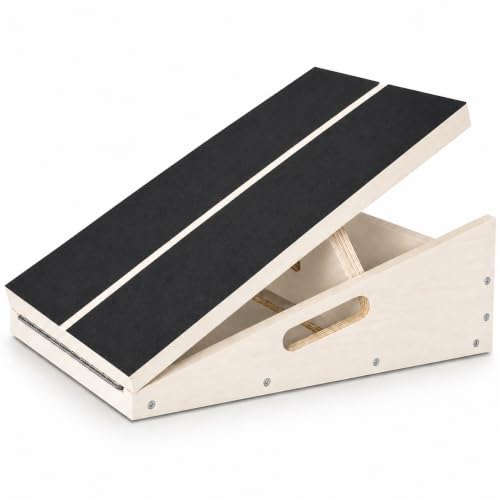
- Five settings from 15° to 35°
- Reinforced wood supports up to 500 pounds
- Textured top and slip-resistant base
Best For: Runners wanting a stable board for stretching and strength work
Best High-Angle Option

- Four incline positions from 30° to 45°
- Wooden design for stretching and squats
- Portable at approximately 4.5 pounds
Best For: Runners preferring higher-angle mobility and calf stretching
Best with Extra Features
Frylr Folding Wooden Slant Board

- Four adjustable angles from 20° to 40°
- Folding design with carry handle and magnetic closure
- Non-slip surface with 500-pound stated capacity
Best For: Runners wanting a sturdy, portable board for regular mobility work
Best Angle Variety
Portable Five-Angle Stretch Board

- Five preset angles from 23° to 45°
- Folds for transport and needs no setup
- Includes workout poster and instructions
Best For: Runners who want fine control over stretching intensity
Best for Deep Stretching
Adjustable Wooden Calf Stretcher
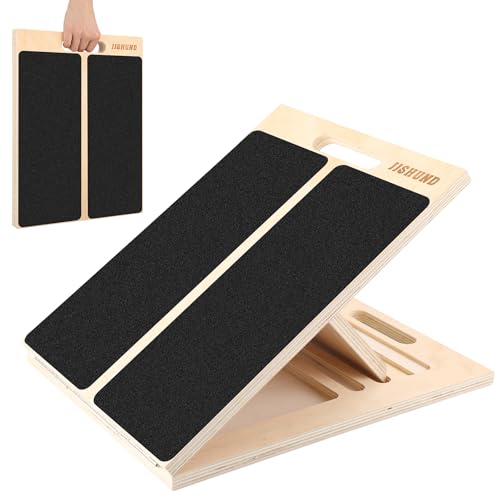
- Five angles include a deep 45° setting
- Foldable design with hollow carry handle
- Sandpaper top and bottom anti-slip pad
Best For: Runners prioritizing progressive and deeper lower-leg stretching
Best Overall – StrongTek Adjustable Wooden Slant Board
For runners seeking a durable slant board for runners, this StrongTek model combines five incline settings with a solid wooden build. Its full-coverage non-slip surface and side handle make it practical for calf stretching, squats, warmups, and recovery work.
Best For: Runners who want a sturdy, adjustable board for regular stretching and rehabilitation exercises.
Pros:
- Five adjustable angles from 15° to 35°
- Wood construction with anti-slip safety treads
- Side handle supports easier portability
- Large 12.5-by-16-inch platform
Cons:
- At 9 pounds, it is heavier than foam or compact folding options
- Its wooden design may require more storage space
This is a strong all-purpose choice when stability and durability matter more than minimum weight. It offers a useful range of inclines for progressive calf and ankle work.
Best Portable Foam Option – Lightweight Squat Wedge Block
This lightweight slant board for runners is designed for portability, with detachable foam wedges that can be used together or individually. Its multiple angles support calf stretching, ankle mobility, squats, and physical therapy at home, in the office, or while traveling.
Best For: Runners who prioritize low weight, easy cleaning, and flexible positioning.
Pros:
- Weighs only 10.56 ounces
- Five listed angle settings, including 8.5°, 17°, 25.5°, 34°, and 180°
- Foldable, detachable, and easy to carry
- Waterproof, oil-proof, and wipe-clean EPP material
Cons:
- The foam wedge has a smaller 12-by-6-inch footprint
- Its lightweight construction may feel less substantial than a wooden board
Choose this model when portability is the deciding factor. The modular wedge design is convenient for runners who want to add calf and ankle mobility work beyond the home gym.
Best Wide Platform – StrongTek Foldable Slant Board
With a 13-inch-wide platform and five settings, this slant board for runners gives your feet room for squats, lunges, calf raises, and progressive stretching. The abrasive top, rubber bottom pads, and foldable carry-handle design add stability and storage convenience.
Best For: Runners who want extra foot space and a board suitable for strength training as well as mobility work.
Pros:
- Five incline settings from 15° to 35°
- 13-inch-wide platform supports natural foot placement
- Anti-slip top and bottom help secure the board and protect floors
- Supports up to 350 pounds and folds for storage
Cons:
- At 5.3 pounds, it is not the lightest option
- The wooden platform may be less convenient for frequent travel than foam
This is a practical pick for runners who want one board for stretching and lower-body training. Its wider base is especially useful if narrow boards make your stance feel cramped.
Best With Resistance Bands – Adjustable Calf Stretch Board
This slant board for runners adds two resistance bands to a five-angle wooden board, giving you more options for calf, ankle, leg, and rehabilitation exercises. The non-slip EVA base and PVC sandpaper surface are designed to help keep the board secure during use.
Best For: Runners who want a stretching board bundled with bands and basic exercise guidance.
Pros:
- Five adjustable angles from 23° to 45°
- Includes two TPE resistance bands with different tension levels
- Includes an exercise guide poster and instruction manual
- 11-layer poplar wood core with non-slip surfaces
Cons:
- Its listed 11.77-by-15.55-inch dimensions provide less width than some wide-platform boards
- The included resistance bands add equipment but may not suit every runner’s routine
This set is a good choice when you want more than passive calf stretching. The included bands and guide make it a versatile option for runners building a broader mobility or rehabilitation routine.
Best Portable Pick – Compact ABS Slant Board
The StrongTek is a practical slant board for runners who want adjustable calf and ankle stretching in a compact package. Its five incline settings, textured surface, heel lip, and lightweight ABS construction make it easy to use at home, in an office, or while traveling.
Best For: Runners seeking a portable board for calf stretching, ankle mobility, warm-ups, and recovery work.
Pros:
- Five adjustable angles from 15° to 45° for progressive stretching.
- Textured anti-slip surface and heel support help keep feet positioned.
- Lightweight 3.7-pound ABS design supports up to 300 pounds.
- Compact size is easy to store, carry, and clean.
Cons:
- Plastic construction may feel less substantial than a wooden board.
- Its 300-pound capacity is lower than some heavy-duty alternatives.
This is a versatile choice for runners who prioritize portability and multiple angle options. It is especially convenient when stretching equipment needs to move between locations.
Best Heavy-Duty Pick – 500-Lb Wooden Calf Stretch Board
This wooden slant board for runners is built for stability during calf stretching, ankle mobility drills, squats, and calf raises. Its five angle settings and 500-pound capacity make it a strong option for structured training at home or in the gym.
Best For: Runners who want a sturdy wooden board for stretching, warm-ups, mobility work, and strength exercises.
Pros:
- Five settings from 15° to 35° support gradual progression.
- Wooden construction provides a stable platform with a 500-pound capacity.
- Textured top and slip-resistant base help provide secure footing.
- Side handle, exercise guide, and three-year warranty add convenience.
Cons:
- At 3.85 pounds, it is heavier than the compact ABS option.
- Its maximum 35° angle may offer less intensity than boards reaching 45° or higher.
Choose this model if stability and load capacity matter more than minimum weight. The moderate angle range is well suited to controlled stretching and progressive mobility routines.
Best High-Angle Option – Portable Wooden Stretch Board
This portable slant board for runners offers four higher incline positions, making it useful for calf stretching, squats, and weight-bearing mobility exercises. The wooden design weighs about 4.5 pounds and is intended for use at home, in the office, gym, or physiotherapy setting.
Best For: Runners who prefer higher-angle stretching and a portable wooden board for mobility or rehabilitation routines.
Pros:
- Four adjustable positions from 30° to 45°.
- Wood construction suits stretching, squats, and weight-bearing exercises.
- Portable design weighs approximately 4.5 pounds.
- Suitable for beginners, athletes, and rehabilitation use.
Cons:
- It offers fewer adjustment positions than the five-angle alternatives.
- The supplied details do not specify a weight capacity or slip-resistant surface.
- Its starting angle of 30° may be less gentle for beginners seeking a mild stretch.
This board is a good fit when a higher starting angle and 45° maximum incline are priorities. Consider another option if you need a stated load rating or more gradual angle progression.
Best with Extra Features – Frylr Folding Wooden Slant Board
The Frylr is a versatile slant board for runners who want adjustable calf, ankle, and lower-body stretching at home, in the gym, or at the office. Its four incline settings, foldable design, and carry handle make it practical for warm-ups, recovery, and mobility breaks.
Best For: Runners seeking a sturdy, portable board with multiple incline options and compact storage.
Pros:
- Adjusts to 20°, 25°, 30°, and 40° for different stretching intensities.
- Folds with a magnetic closure and integrated carry handle for transport.
- Wide non-slip surface and bottom grip pads support a planted stance.
- 12-layer wood construction is rated for up to 500 pounds.
Cons:
- At about 5 pounds, it is not the lightest option in this roundup.
- The four-angle range offers fewer settings than some competing boards.
This is the strongest all-around choice if you value stability, portability, and a durable wooden build. The adjustable range is well suited to gradual calf and ankle mobility work before or after a run.
Best Angle Variety – Portable Five-Angle Stretch Board
This portable slant board for runners provides five incline settings, making it easy to fine-tune calf and lower-leg stretching from a gentler starting point to a deeper challenge. It folds for transport and requires no setup, so it can move between home, work, and the gym.
Best For: Runners who want the widest selection of preset angles for progressive stretching.
Pros:
- Offers five angles: 23°, 30°, 35°, 40°, and 45°.
- Folds for easy carrying and storage with no assembly required.
- Can be used for calves, glutes, heels, ankles, and leg mobility.
- Includes a workout poster and instructions.
Cons:
- The listed maximum weight recommendation is 300 pounds.
- No warranty is specified in the supplied product details.
With five clearly defined positions, this board is a useful pick for runners who prefer to progress gradually or vary stretching intensity across warm-ups and recovery sessions. Its 4.6-pound weight also keeps it reasonably portable.
Best for Deep Stretching – Adjustable Wooden Calf Stretcher
This adjustable slant board for runners combines five angle settings with an enlarged anti-slip surface and bottom grip pad. Its angle progression includes a low 20° setting for introductory mobility work and a 45° position for deeper stretching, while the hollow handle supports portability.
Best For: Runners who want a compact board with a deep 45° setting and built-in anti-slip features.
Pros:
- Provides five angles: 20°, 30°, 35°, 40°, and 45°.
- Hollow handle and foldable construction make it easier to carry and store.
- Sandpaper surface and bottom anti-slip pad help reduce movement.
- Thickened multilayer wood uses a triangular support structure.
Cons:
- Its stated load capacity is about 200 pounds, lower than the other listed options.
- It has no supplied warranty information.
This board stands out for runners who want a clearly staged path from gentle ankle work to deeper calf or Achilles-area stretching. The lower weight capacity makes checking fit especially important, but the anti-slip design adds practical reassurance during use.
How We Picked the Best Slant Board for Runners
We evaluated each board for the features that matter during regular running recovery and mobility work: angle adjustability, surface traction, construction, weight capacity, portability, and ease of storage. We also considered whether a design supports more than calf stretching, such as squats, ankle-mobility drills, Pilates, or physical-therapy exercises.
Because product specifications can vary by seller and version, confirm the listed dimensions, angle range, and weight rating before ordering. A higher capacity is useful for stability, but it does not automatically mean the board is more comfortable or better suited to your foot size.
Quick Comparison
- Best for adjustability: Choose a board with several clearly defined incline positions, especially if you alternate between gentle mobility work and deeper calf stretches.
- Best for portability: Compact plastic or foldable wooden models are easier to carry to the gym, office, or starting line.
- Best for stability: Look for a broad platform, grippy contact points, and a weight rating that comfortably exceeds your body weight plus exercise load.
- Best for versatility: Wider wooden boards and models with a resistance band can support stretching, squats, and additional lower-body movements.
Key Buying Factors for a Slant Board for Runners
Angle Range and Adjustment
A fixed wedge can work well if you already know your preferred stretch intensity, but adjustable boards offer more flexibility. Start with a modest incline and increase gradually as your ankle mobility improves. Multiple positions are also helpful when two people share the board.
Traction and Stability
Non-slip surfaces and secure adjustment mechanisms help keep your feet and the board in place. Use the board on a hard, level surface, and avoid relying on a loose mat if it causes rocking. Side handles can make some wooden models easier to reposition.
Materials, Size, and Capacity
Wood often feels solid and durable, while ABS plastic can reduce weight and simplify transport. Check platform width if you have larger feet or want to use the board for squats. Capacity ratings are useful reference points, but inspect the hinges, support legs, and base rather than judging strength from the headline number alone.
Portability and Storage
Runners who travel or train at multiple locations may prefer a foldable or lightweight model. For home use, a wider board may provide better confidence and comfort even if it takes up more storage space.
Who Should Buy Which Slant Board for Runners?
Choose a multi-angle board if you want one tool for warmups, cooldowns, ankle mobility, and progressive stretching. Choose a sturdy wooden model if home stability and a solid feel matter most. Choose a plastic or foldable option if you need a lightweight board for travel. Choose a wider, high-capacity design if you plan to perform squats or share the equipment.
No slant board replaces a gradual training plan or professional care for persistent pain. Use a comfortable range of motion, stop if stretching causes sharp pain, and ask a qualified clinician for guidance after an injury.