A slant board can make calf stretching, ankle mobility work, squats, and balance exercises easier to perform consistently. The right design gives you a stable incline without taking over your workout space.
We compared these 10 options by adjustability, traction, weight capacity, portability, and everyday usability so you can choose a board that fits your routine and comfort level.
Best 10 Slant Board for Mobility Picks for 2026
Best Adjustable Wood Pick

- Five settings from 15° to 35°
- Anti-slip treads and hardwood construction
- Side handle; no assembly required
Best For: Calf stretching, ankle mobility, and rehabilitation routines
Best Multi-Function Pick
3-in-1 Slant and Balance Board

- Slant, rocker, and wobble modes
- Includes a resistance band
- Folds flat with anti-slip surface
Best For: Mobility, balance training, squats, and home workouts
Best Wide Platform
StrongTek 13-Inch Adjustable Board

- 13-inch-wide platform for natural stance
- Five settings from 15° to 35°
- Foldable with top and bottom grip
Best For: Squats, calf raises, and progressive ankle mobility
Best Complete Stretching Set
Calf Stretch Slant Board with Bands

- Five angles from 23° to 45°
- Includes two resistance bands and guides
- Lightweight with non-slip base and top
Best For: Portable calf stretching, therapy, and guided mobility routines
Heavy-Duty Pick
HANDBODE Five-Angle Slant Board

- 660-lb steel-frame capacity
- Five angles from 15° to 40°
- Folds flat with no assembly
Best For: Stable home-gym mobility work and higher-load training
Most Versatile
Wooden Five-Angle Calf Stretch Board
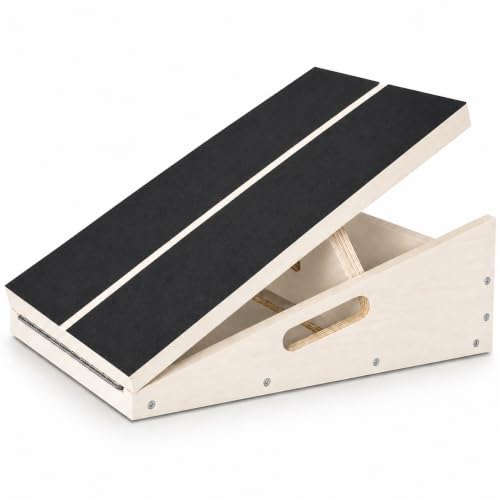
- Five angles from 15° to 35°
- 500-lb wooden platform
- Handles and visual exercise guide included
Best For: Progressive calf stretching, ankle mobility, and warmups
Lightweight Option
Portable Four-Position Wooden Slant Board

- Weighs about 4.5 to 5 pounds
- Four settings from 30° to 45°
- Designed for home, office, gym, or clinic use
Best For: Portable stretching and higher-angle mobility routines
Most Portable

- Folds with a carry handle and magnetic closure
- Four adjustable angles from 20° to 40°
- Non-slip wooden platform for stretching and squats
Best For: Portable home, office, and gym mobility routines
Beginner-Friendly Range

- Five incline settings from 23° to 45°
- Folding design needs no setup
- Includes a workout poster and instructions
Best For: Progressive calf and lower-body stretching
Most Versatile Kit
FeelGoodEase Mobility Slant Board

- Five settings from 15° to 35°
- Includes band, pads, and replacement sandpaper
- Built for stretching, squats, balance, and mobility
Best For: Multi-purpose lower-body training and mobility
Best Adjustable Wood Pick – StrongTek Wooden Slant Board
If you want a traditional slant board for mobility with several incline options, this StrongTek model offers five settings from 15 to 35 degrees. Its hardwood plywood construction, anti-slip treads, and side handle make it practical for calf stretching, squats, warm-ups, and recovery routines.
Best For: Users seeking a sturdy, adjustable board for calf and ankle stretching, rehabilitation, and everyday mobility work.
Pros:
- Five adjustable angles support gradual stretching and different fitness levels.
- Anti-slip treads help keep feet secure during exercises.
- Hardwood plywood construction and a side handle support durability and portability.
- Ready to use with no assembly required.
Cons:
- At 9 pounds, it is heavier than several portable alternatives.
- The listed dimensions may take more storage space than a compact folding board.
This is a straightforward choice when stability and familiar wood construction matter more than extra workout features. The five-angle range also makes it suitable for progressing gradually.
Best Multi-Function Pick – 3-in-1 Slant and Balance Board
This versatile slant board for mobility doubles as a 180-degree rocker and 360-degree wobble trainer. It can support calf stretching, heel-elevated squats, balance work, and calf raises, while the included resistance band adds another option for home workouts.
Best For: Exercisers who want one board for mobility, balance training, strength work, and recovery.
Pros:
- Three training modes cover slant, rocker, and wobble exercises.
- Locking mechanism holds a fixed incline and releases for balance modes.
- Textured anti-slip surface and a stated 500-pound capacity support secure use.
- Includes a resistance band and folds flat for carrying or storage.
Cons:
- Its multi-function design may be more equipment than needed for simple stretching.
- The supplied notes do not specify the available fixed incline angles.
Choose this model if variety is a priority. It is more than a dedicated calf stretcher, making it appealing for users who want balance and resistance-training options in the same compact piece of equipment.
Best Wide Platform – StrongTek 13-Inch Adjustable Board
For users who prefer more room underfoot, this StrongTek slant board for mobility has a 13-inch-wide platform and five settings from 15 to 35 degrees. Its high-grip top, rubber base pads, foldable design, and carry handle make it suited to squats, lunges, calf raises, and progressive ankle mobility work.
Best For: Beginners, athletes, and rehabilitation users who want a wider, stable platform for lower-body exercises.
Pros:
- Extra-wide platform allows more natural foot placement.
- Five incline settings support gradual progression.
- Anti-slip top and bottom help secure the board and protect hard floors.
- Foldable body and integrated handle simplify storage and transport.
Cons:
- The stated 350-pound capacity is lower than some competing models in this roundup.
- Its 15.5-inch length may be less compact than a smaller travel board.
This is a practical option for anyone who finds narrow slant boards uncomfortable. The combination of width, adjustable angles, and bottom grip makes it especially useful for controlled, progressive training.
Best Complete Stretching Set – Calf Stretch Slant Board with Bands
This portable slant board for mobility combines five adjustable angles, a non-slip surface, and two resistance bands. The included training poster and instruction manual make it a useful starter set for calf stretching, physical therapy exercises, rehabilitation, and lower-body mobility work.
Best For: Users who want a lightweight stretching board with resistance accessories and basic exercise guidance.
Pros:
- Five settings range from 23 to 45 degrees for adjustable challenge.
- Non-slip EVA base and PVC sandpaper surface help limit movement.
- Includes two resistance bands with different stated tension levels.
- Lightweight design is easy to carry between home, office, gym, and therapy settings.
Cons:
- The product details list different maximum capacities in the supplied notes, so buyers should verify the current specification.
- Its 11.77-inch depth provides less front-to-back space than some larger boards.
- The highest 45-degree setting may be demanding for beginners.
This set stands out for value and portability rather than a wide platform. The bands and printed guidance make it a convenient choice for users building a simple mobility or rehabilitation routine.
Heavy-Duty Pick – HANDBODE Five-Angle Slant Board
If you want a sturdy slant board for mobility work, the HANDBODE combines a steel frame, wooden platform, and five incline settings. Its broad, textured surface is suited to calf stretches, ankle drills, heel raises, and squat preparation.
Best For: Home gyms and users who prioritize a high weight capacity, adjustable angles, and a firm platform.
Pros:
- Steel frame supports up to 660 lb.
- Five settings from 15 to 40 degrees suit different mobility and training needs.
- Sand-grain traction surface supports contact with bare feet, socks, or training shoes.
- Folds for storage and requires no assembly.
Cons:
- The 12 x 15.7-inch platform may feel compact for some stances.
- Its steel-and-wood construction may be less convenient to carry than a lightweight board.
The HANDBODE is a practical choice when stability and load capacity matter most. The wide angle range also lets you begin with a gentler position and progress as comfortable.
Most Versatile – Wooden Five-Angle Calf Stretch Board
This wooden slant board for mobility offers five settings from 15 to 35 degrees, making it easy to tailor calf stretches, ankle mobility drills, warmups, and squat practice. Its textured top and slip-resistant base are designed for controlled use.
Best For: Beginners, runners, and home or gym users seeking a versatile wooden board with helpful carrying and exercise-guide features.
Pros:
- Five angle settings support gradual progression.
- 500-lb capacity and reinforced wooden construction provide a stable platform.
- Textured top and slip-resistant base help with secure positioning.
- Side handles and the included visual exercise guide improve portability and usability.
Cons:
- Its 15° to 35° range does not reach the 40° setting offered by some boards.
- At 3.85 kg, it is not the lightest portable option.
With a broad range of recommended uses and a three-year manufacturer warranty, this board is a well-rounded option for regular stretching, rehabilitation-oriented routines, and strength work.
Lightweight Option – Portable Four-Position Wooden Slant Board
For mobility work away from a dedicated gym, this portable slant board for mobility weighs about 4.5 to 5 pounds and offers four incline positions. It can support stretching and weight-bearing exercises at home, in an office, gym, or physiotherapy setting.
Best For: Users who value portability and want higher-angle settings for stretching, squats, and rehabilitation-oriented routines.
Pros:
- Lightweight design is convenient to transport.
- Four settings—30°, 35°, 40°, and 45°—offer relatively steep inclines.
- Suitable for beginners, athletes, and different workout environments.
- Wood construction provides a simple, compact training surface.
Cons:
- It offers fewer adjustment positions than the five-angle boards in this roundup.
- The supplied notes do not specify a weight capacity or non-slip surface.
- Its angle range starts at 30°, which may be too steep for some beginners.
This board stands out for easy transport and its 45° maximum incline. Consider it when portability and steeper settings are more important than a documented load rating or broader low-angle adjustment.
Most Portable – Frylr Folding Slant Board
If you want a slant board for mobility that is easy to keep nearby or carry between locations, the Frylr model is a practical option. Its folding wooden design includes a carry handle and magnetic closure, while four incline settings support calf stretching, warm-ups, recovery, and squat practice.
Best For: Home, office, or gym users who prioritize portability, compact storage, and adjustable lower-body mobility work.
Pros:
- Folds to a compact size and includes an integrated carry handle.
- Offers four incline positions: 20°, 25°, 30°, and 40°.
- Uses a wide non-slip surface, bottom grip pads, and a layered wooden structure.
- Rated in the supplied notes for up to 500 pounds.
Cons:
- Provides fewer angle settings than some five-position boards.
- The supplied notes list differing weight and dimension details, so verify the current specifications before buying.
The Frylr stands out when storage and transport matter as much as stretching functionality. Its folding frame and stable surface make it convenient for regular mobility breaks, though shoppers should confirm the listing specifications because the supplied details are inconsistent.
Beginner-Friendly Range – Five-Angle Calf Stretch Board
This five-angle model is a straightforward slant board for mobility for users who want a broad range of calf-stretching intensity without assembly. The wooden board folds for transport and supports use with one or both feet for stretching, yoga, and general lower-body flexibility work.
Best For: Beginners and experienced exercisers seeking five incline choices and a simple portable board for calves, ankles, heels, glutes, and legs.
Pros:
- Adjusts to five angles: 23°, 30°, 35°, 40°, and 45°.
- Folds for transport and requires no setup.
- Includes a workout poster and instructions.
- Designed for multiple lower-body stretching and mobility exercises.
Cons:
- The supplied details list both a 300-pound maximum recommendation and a 460-pound highlight, creating specification uncertainty.
- No warranty is listed in the supplied product details.
The main appeal is its five-position range, which lets you progress from easier to more demanding stretches. It is a useful basic choice, but confirm the applicable weight limit before placing significant load on the board.
Most Versatile Kit – FeelGoodEase Mobility Slant Board
For shoppers seeking a slant board for mobility that also supports squats, balance work, and stretching, this FeelGoodEase board offers a versatile setup. It combines five incline positions with a non-slip surface, reinforced construction, a resistance band, replacement sandpaper, and four non-slip pads.
Best For: Users who want one board for calf and ankle mobility, squat practice, balance exercises, and broader lower-body training.
Pros:
- Provides five settings: 15°, 20°, 25°, 30°, and 35°.
- Includes a resistance band, four non-slip pads, and extra sandpaper.
- Supplied notes describe a 500-pound capacity and reinforced construction.
- Supports stretching, squats, mobility, and balance exercises.
Cons:
- The supplied dimensions are relatively compact at 13 by 7 by 3.5 inches, which may offer less foot room than wider boards.
- The product is made from engineered wood rather than solid wood.
This is the strongest all-around option of the three for buyers who want accessories and a lower starting angle for gradual mobility work. Its compact footprint may be a trade-off for users who prefer a wider standing platform.
How We Picked the Best Slant Board for Mobility
We focused on the features that matter most during stretching and mobility work: dependable construction, useful incline settings, a secure non-slip surface, and enough width to place both feet comfortably. We also considered portability, storage, stated weight capacity, handles, folding designs, and included accessories such as resistance bands.
Because product specifications can vary by seller and model version, verify the current dimensions, materials, angle range, and load rating before purchasing. A stated weight capacity is not a substitute for a stable surface or appropriate supervision during rehabilitation exercises.
Quick Comparison
| Best For | Features to Prioritize | Good Choice If You Want |
|---|---|---|
| Daily calf stretching | Multiple angle settings, textured traction | Simple, repeatable sessions |
| Balance and strengthening | Wide platform, rigid frame, high capacity | More than basic stretching |
| Travel or small spaces | Folding design, low weight, carrying handle | Easy storage and transport |
| Rehabilitation routines | Gradual adjustability, stable base | Controlled progression |
Key Buying Factors for a Slant Board for Mobility
Angle Adjustability
Several incline positions let you begin with a gentler stretch and increase the challenge gradually. Five-angle designs are particularly useful when more than one person will use the board or when your mobility changes over time.
Traction and Stability
Look for a genuinely non-slip foot surface and a base that stays planted on your floor. Rubber feet, textured platforms, and a rigid frame can reduce movement, but use the board on a clear, level surface. Avoid exercising on wet or uneven flooring.
Size, Capacity, and Construction
Check the platform width and length, especially if you have larger feet or plan to use the board for squats and balance exercises. Wood can feel sturdy and natural, while steel-reinforced models may offer greater rigidity. Choose a capacity comfortably above your body weight rather than treating the maximum rating as a target.
Portability and Storage
A foldable or compact board is easier to keep available, which can improve consistency. Handles help with carrying, while a fixed, heavier model may be preferable if maximum stability matters more than portability.
Who Should Buy Which Slant Board for Mobility?
Choose a basic adjustable wooden board if your priority is calf and ankle stretching at home. Select a wider, high-capacity model if you also want to practice squats, balance drills, or strength-focused mobility exercises. A foldable design makes the most sense for apartments, travel, or shared workout areas. If you want added exercise variety, a model bundled with resistance bands or designed for balance work may provide better value.
For pain, injury recovery, or physical therapy, favor controlled angle adjustments and a stable platform, and follow guidance from a qualified clinician. Start at the lowest comfortable incline, keep movements slow, and stop if stretching becomes painful, sharp, or causes numbness.