The best slant boards can make calf stretches, heel-elevated squats, and ankle-mobility drills easier to perform consistently at home or in the gym. The right model should feel stable, offer a useful incline range, and suit your space and training goals.
We compared 10 wooden and wedge-style options by adjustability, traction, weight capacity, portability, and overall versatility so you can choose with confidence.
Best 10 Slant Boards Picks for 2026
Best Overall Wooden Slant Board
StrongTek Adjustable Slant Board

- Five angles from 15° to 35°
- Durable hardwood construction
- Anti-slip surface with carry handle
Best For: Versatile stretching, squats, and mobility work
Best for Heavy Squats

- Supports loads up to 1,500 pounds
- 15° heel-elevated squat angle
- Includes bag and training poster
Best For: Squats, weightlifting, and heel-elevated mobility work
Best Wide Adjustable Pick

- Five settings from 15° to 35°
- Wide 13-inch exercise platform
- Folds with an integrated carry handle
Best For: Progressive mobility work and lower-body exercises
Best Lightweight Option
TEMI Portable Wooden Slant Board

- Four angles from 20° to 40°
- Portable 5-pound wooden design
- Stated 500-pound weight capacity
Best For: Travel-friendly stretching, mobility, and squat training
Best Adjustable Wooden Pick
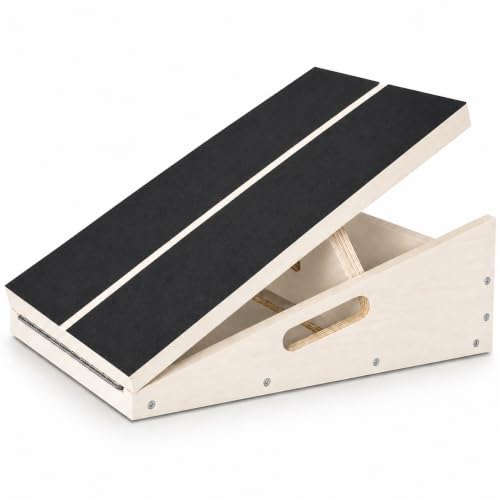
- Five settings from 15° to 35°
- 500 lb stated capacity
- Textured top and slip-resistant base
Best For: Progressive stretching, ankle mobility, and squat practice
Best for Everyday Use

- Weighs about 5 pounds
- Four positions from 30° to 45°
- Designed for stretching and rehabilitation
Best For: Portable mobility, calf stretching, and recovery routines
Best Foldable Design

- Folds for compact storage
- Four settings from 20° to 40°
- Non-slip surface and 500 lb stated capacity
Best For: Portable home, office, and gym mobility routines
Best High-Capacity Pick
Adjustable Wooden Calf Stretch Board

- 460-pound capacity with lightweight wooden construction
- Five angles from 23° to 45°
- Textured surface and non-slip EVA base
Best For: Portable calf stretching, mobility work, and heel-elevated squats
Best Modular Option

- Three wedges create multiple configurations
- Lightweight, shape-retaining EPP material
- Supports stretching, squats, calf raises, and step-ups
Best For: Adaptable home workouts and mobility routines
Best Portable Pick
Foldable Adjustable Calf Stretcher
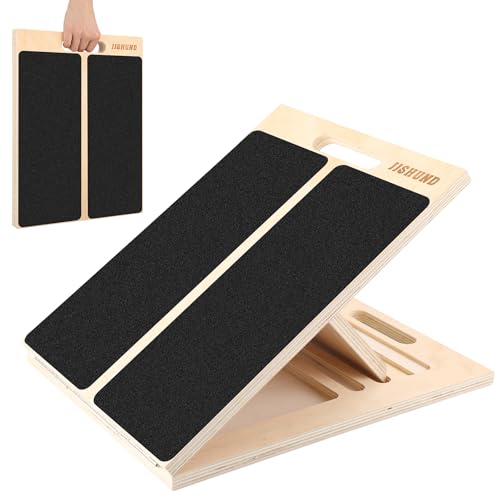
- Foldable design with a built-in carry handle
- Five angles from 20° to 45°
- Anti-slip top and bottom surfaces
Best For: Portable calf and ankle stretching from beginner to advanced levels
Best Overall Wooden Slant Board – StrongTek Adjustable Slant Board
If you want a versatile set of slant boards for stretching, squats, and mobility work, the StrongTek Wooden Slant Board offers five adjustable incline positions from 15 to 35 degrees. Its hardwood construction, anti-slip treads, and side handle make it practical for home workouts, rehabilitation routines, and portability.
Best For: Users seeking a sturdy, adjustable board for calf stretching, ankle mobility, squats, and recovery-focused exercise.
Pros:
- Five incline settings support different flexibility and fitness levels.
- Hardwood plywood construction is designed for durability.
- Anti-slip treads and an integrated side handle improve usability.
- Ready to use without assembly.
Cons:
- At 9 pounds, it is heavier than some portable wedge-style options.
- The larger 12.5-by-16-inch format may require more storage space.
This is a strong all-purpose choice when adjustability and solid wood construction matter more than minimum weight. It is especially useful for users who want one board to cover stretching, squats, and rehabilitation exercises.
Best for Heavy Squats – 1500-Lb Squat Wedge Block
For squat-focused training, this pair of slant boards uses a 15-degree heel elevation to support deeper squats, weightlifting, and ankle-mobility work. The high-density ABS core, silicone anti-slip surface, and full-foot design provide a stable platform for demanding workouts.
Best For: Lifters who want heel elevation for squats, knees-over-toes training, and lower-body mobility drills.
Pros:
- Rated for up to 1,500 pounds of load.
- Full-foot support measures 11.8 by 5.9 inches.
- Textured silicone surface helps reduce slipping.
- Includes a carrying bag, training poster, and instruction guide.
Cons:
- Offers a fixed 15-degree angle rather than multiple incline settings.
- Its squat-wedge design is less versatile than a larger adjustable stretching board.
This option prioritizes stability and load capacity over angle adjustment. Choose it if your main goal is supported squatting and heel elevation, particularly for barbell, Smith-machine, or Bulgarian squats.
Best Wide Adjustable Pick – StrongTek 13-Inch Slant Board
This StrongTek slant board combines five incline settings from 15 to 35 degrees with a 13-inch-wide platform. The extra width allows a more natural stance for squats, lunges, and calf raises, while the foldable design and carry handle simplify storage and transport.
Best For: Beginners, athletes, and rehabilitation users who want a wide, adjustable board for progressive mobility training.
Pros:
- Five angles allow gradual progression in stretching and mobility work.
- 13-inch-wide platform accommodates standard lower-body exercises.
- High-grip top and rubber bottom pads improve stability.
- Supports up to 350 pounds and folds for compact storage.
Cons:
- Its 350-pound capacity is lower than the squat wedge’s stated rating.
- The 5.3-pound weight may be less convenient than smaller wedges.
With its wide platform and folding structure, this is a practical middle ground between a compact wedge and a larger rehab board. It is a particularly good fit for users who value stance room and adjustable progression.
Best Lightweight Option – TEMI Portable Wooden Slant Board
The TEMI wooden slant board is designed for portable calf stretching, squats, balance work, and ankle mobility. Weighing about 5 pounds and measuring 11.8 by 15.7 inches, it offers four incline positions—20, 25, 30, and 40 degrees—along with a built-in handle.
Best For: Users who want a portable wooden board for home, office, gym, travel, or rehabilitation routines.
Pros:
- Lightweight design and built-in handle support easy transport.
- Four incline angles accommodate different stretching and training needs.
- Wooden construction and anti-slip surface provide a stable exercise base.
- Stated 500-pound weight capacity supports a broad range of users.
Cons:
- It has fewer angle settings than the five-position StrongTek models.
- The supplied notes do not specify a separate bottom anti-slip pad.
This board is a convenient choice when portability is a priority without giving up adjustable inclines. Its 40-degree maximum angle also makes it suitable for users seeking a stronger stretch or more advanced positioning.
Best Adjustable Wooden Pick – 5-Angle Calf Stretch Board
This adjustable wooden slant board is a practical choice if you want several incline options for calf stretching, ankle mobility, squats, and warm-ups. Its five settings range from 15° to 35°, making it suitable for gradually adjusting stretch intensity at home or in the gym.
Best For: Users who want a sturdy, adjustable board with a high stated weight capacity for stretching, mobility work, and controlled lower-body exercises.
Pros:
- Five angle settings from 15° to 35° support progressive stretching.
- Wooden construction has a stated 500 lb capacity.
- Textured top and slip-resistant base help provide secure footing.
- Side handles, an exercise guide, and a 3-year warranty add convenience.
Cons:
- At 3.85 kg, it is heavier than some portable slant boards.
- The 16-by-12.5-inch platform may be less convenient for users seeking a larger standing surface.
Choose this model if angle flexibility and a substantial wooden build matter more than minimizing weight. It is especially useful for gradually progressing from gentle calf stretches to more demanding mobility or squat practice.
Best for Everyday Use – Portable Wooden Slant Board
This portable wooden slant board is designed for stretching and weight-bearing exercises across several settings. With four incline positions from 30° to 45° and a weight of about 5 pounds, it can move between home, office, gym, or physical therapy spaces with relative ease.
Best For: Beginners, athletes, and rehabilitation-focused users who want a lightweight board for calf stretching, mobility work, and recovery routines.
Pros:
- Lightweight design weighs about 5 pounds for easier transport.
- Four adjustable positions range from 30° to 45°.
- Suitable for stretching, squats, physical therapy, and rehabilitation training.
- Wood construction offers a simple, portable setup.
Cons:
- It starts at a 30° angle, so it does not offer the gentler settings found on some boards.
- The supplied notes do not list a specific weight capacity or slip-resistant base.
- Its compact 15.74-by-11.81-inch size may not suit users wanting a wider platform.
This is a sensible pick when portability and a higher range of incline settings are priorities. Consider another option if you specifically need a very low starting angle, a stated high weight capacity, or detailed traction features.
Best Foldable Design – Portable 500 lb Slant Board
This foldable wooden slant board stands out for compact storage and transport. It adjusts to 20°, 25°, 30°, and 40°, while its folding frame, magnetic closure, and integrated carry handle make it convenient for home, office, and gym use.
Best For: Users who want a portable slant board that folds away easily without giving up a stated 500 lb capacity.
Pros:
- Folding design measures about 11.8 by 15.7 by 1.2 inches when folded.
- Four incline settings support warm-ups, stretching, and mobility work.
- 12-layer wood construction has a stated 500 lb capacity.
- Wide non-slip foot surface, bottom grip pads, carry handle, and magnetic closure improve practicality.
Cons:
- The supplied details list conflicting weight information, so buyers should verify the shipping or product weight.
- It has four settings rather than the five offered by some adjustable boards.
- The listed warranty is 1 year, shorter than some comparable options.
For small spaces or routines that move between locations, this is the most storage-friendly choice of the three. Its combination of folding construction, traction features, and high stated capacity makes it a versatile option for everyday stretching and lower-body exercise.
Best High-Capacity Pick – Adjustable Wooden Calf Stretch Board
If you want slant boards that combine adjustable angles with a sturdy wooden platform, this model is a practical choice for stretching, warm-ups, cooldowns, and heel-elevated squats. Its five settings accommodate different flexibility levels, while the textured surface and EVA base help provide traction.
Best For: Users who want a portable, high-capacity slant board for calf stretching, mobility work, and squats.
Pros:
- Supports up to 460 pounds while weighing about 4.5 pounds.
- Five incline settings from 23° to 45° allow gradual progression.
- Textured PVC surface and non-slip EVA base improve traction.
- Arrives assembled and includes a training poster and instruction guide.
Cons:
- The wooden design may be less cushioned than foam alternatives.
- It is intended for manual angle adjustment rather than quick changes during movement.
This is one of the more versatile slant boards in the group, especially for heavier users or anyone who values a broad range of incline settings. Its included guide and portable design also make it suitable for home, gym, office, or clinic use.
Best Modular Option – Stackable EPP Squat Wedge Set
For shoppers who prefer adaptable slant boards, this set uses separate EPP wedges that can be matched, stacked, or connected for different exercises. The modular design supports calf stretching, heel-elevated squats, calf raises, step-ups, and selected cardio routines.
Best For: Users who want stackable wedges that can serve multiple workout and mobility purposes.
Pros:
- Includes two 8.5° blocks and one 17° block for varied setups.
- High-density EPP is lightweight, durable, and designed to retain its shape.
- Silicone grip points help improve floor contact and reduce movement.
- Can connect into an aerobic step for step-ups and cardio-focused routines.
Cons:
- The supplied set has lower individual angles than the wooden boards.
- Its multi-piece setup may require more assembly and positioning before use.
- The optional stretching strap is not necessarily included with every configuration.
This set stands out among slant boards for exercise because it can shift from a calf stretcher to a squat wedge or step setup. Choose it if modularity matters more to you than having one fixed, foldable platform.
Best Portable Pick – Foldable Adjustable Calf Stretcher
This foldable wooden option is among the more travel-friendly slant boards, with a hollow handle, compact dimensions, and five clearly defined angles. It is designed for calf, ankle, heel, leg, and squat-related stretching at home, in the office, at the gym, or outdoors.
Best For: Beginners and regular exercisers who prioritize portability, foldability, and adjustable stretching intensity.
Pros:
- Foldable design and hollow handle make it easy to carry and store.
- Five angles range from 20° to 45° for introductory through deeper stretching.
- Anti-slip sandpaper surface and bottom pad help limit movement.
- Triangular structure and multilayer wood provide stable support up to about 200 pounds.
Cons:
- Its approximately 200-pound capacity is lower than the first wooden model.
- The wooden platform may feel firmer than a foam wedge.
Among these slant boards, this model is a sensible fit for users who want straightforward angle progression and easy transport. The 20° setting is positioned for early rehabilitation work, while the 45° setting supports deeper stretching for experienced users.
How We Picked the Best Slant Boards
We focused on the features that matter during repeated stretching and strength work: incline adjustability, platform width, surface traction, construction, stated weight capacity, portability, and storage. Adjustable models earned attention for serving multiple users and exercises, while fixed wedges may appeal to shoppers who want a simple, quick setup.
We also considered practical details such as side handles, foldable designs, stackable angles, and whether a board appears suited to barefoot mobility work, shoes, physical-therapy exercises, or loaded squats. Capacity ratings are manufacturer claims, so use them as a comparison point rather than a substitute for careful inspection.
Quick Comparison
- Best for adjustability: Choose a board with several angle settings, especially if you alternate between gentle stretching and deeper squat positioning.
- Best for portability: Look for foldable or lightweight wooden designs with carrying handles.
- Best for heavy training: Prioritize a broad, rigid base and a clearly stated high weight capacity.
- Best for simplicity: A fixed squat wedge is usually faster to position and easier to store.
- Best for angle variety: Stackable wedge sets can provide multiple heights, but they require careful placement and a level surface.
Key Buying Factors for Slant Boards
Angle and Adjustability
A low incline is useful for beginners, tight calves, and longer holds. Higher angles can increase the stretch or support a more heel-elevated squat. Multiple settings offer more flexibility, but confirm that the adjustment mechanism locks securely.
Stability and Traction
Look for a wide footprint, non-slip feet, and a grippy top surface. The board should stay planted when you shift weight forward or perform squats. Avoid using any model on wet, uneven, or slippery flooring.
Size, Capacity, and Comfort
Check the platform width against your shoe size and stance. A compact board stores easily, while a wider one may feel more secure for squats. Select a capacity rating with ample margin for your body weight and any external load.
Portability and Storage
Handles, folding hinges, and low-profile designs make a difference if you move the board between rooms or take it to a gym. Inspect hinges and adjustment hardware regularly for looseness or damage.
Who Should Buy Which Slant Boards?
Beginners and mobility-focused users should start with a stable, adjustable board that includes lower-angle settings. Squat-focused trainees may prefer a broad, high-capacity wedge with strong traction and minimal movement. Travelers or small-space users should prioritize foldable boards or models with handles. Rehabilitation and physical-therapy users should favor gradual angle changes and follow a clinician’s recommendations rather than selecting the steepest setting. If several people will share the equipment, an adjustable model is generally the most versatile choice.